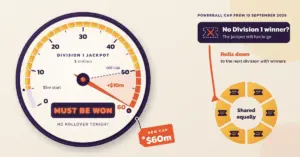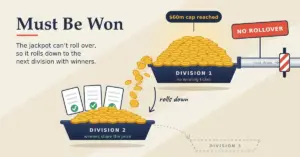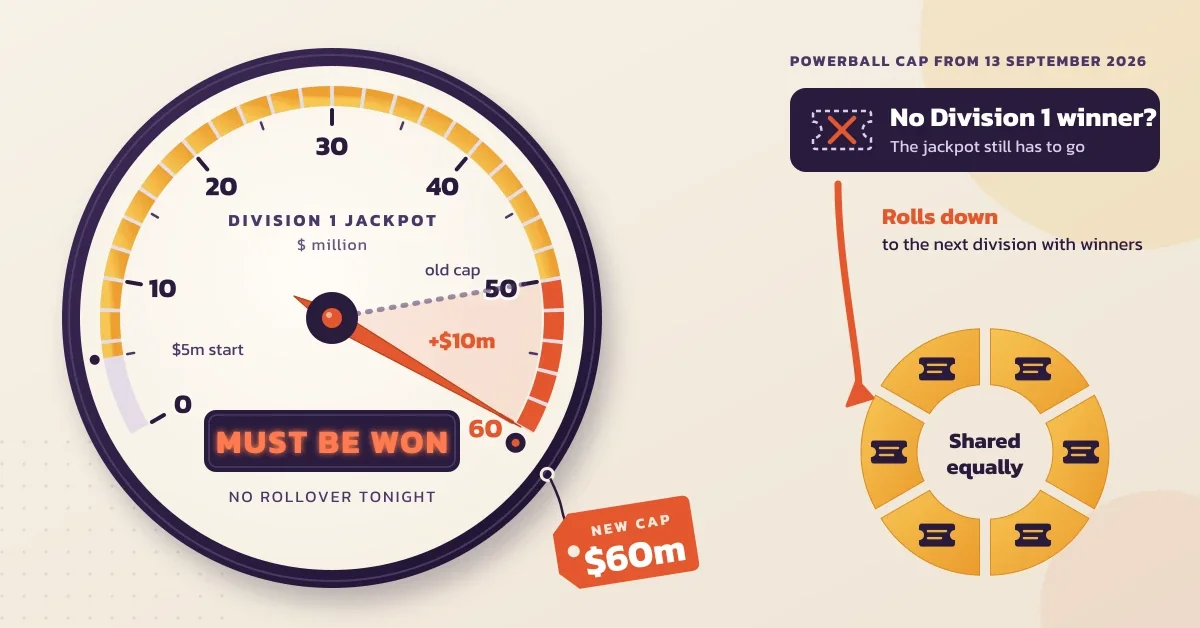
A Powerball Must Be Won draw in New Zealand is a draw where the top Powerball jackpot cannot roll over to another night: it has to be paid out that evening. Since 13 September 2026 it is triggered when the Powerball Division 1 jackpot reaches or exceeds $60 million, the maximum the jackpot can climb to. If no ticket wins Division 1 on the night, the whole jackpot does not disappear or carry over: it rolls down to the next prize division that has winners and is shared equally among them.
Key Facts
- Trigger: a Must Be Won draw is called when the Powerball Division 1 jackpot reaches or exceeds $60 million, the cap since 13 September 2026 (up from $50 million).
- The money must be paid out: on the night, the jackpot cannot roll over to another draw.
- Roll-down: if no ticket wins Division 1, the whole jackpot rolls down to the next division with winners and is shared equally.
- Starting jackpot: $5 million (up from $4 million).
- Division 1 odds: about 1 in 53.7 million per line (previously about 1 in 38.4 million).
- Powerball pool: numbers 1 to 14 (previously 1 to 10); a new Division 8 pays a fixed $12.
- Claiming: prizes can be claimed up to 12 months after the draw date.
What does “Must Be Won” mean in NZ Powerball?
A Must Be Won draw is a draw in which the Powerball jackpot has reached its ceiling and therefore has to be handed out that night instead of growing any further. Normally Powerball “jackpots”, meaning that when nobody wins Division 1, the top prize rolls over and gets bigger for the next draw. That can only continue up to the cap. Once the Division 1 jackpot hits $60 million, Lotto New Zealand calls a Must Be Won draw and the prize is guaranteed to leave the pool that evening.
“Must Be Won” does not mean a single person is guaranteed to win the jackpot. It means the jackpot money must be paid out. There are two ways that happens, and the difference matters: either someone wins Division 1 outright, or the prize rolls down the divisions until it finds winners. This is a Powerball-specific rule, and it works a little differently from the broader Lotto Must Be Won draws that can apply across the games.
Why Powerball has a cap at all
Powerball is an add-on to the main Lotto draw: for an extra cost per line you also get a Powerball number, now drawn from a separate pool of 1 to 14. To win Division 1 you need all six main Lotto numbers plus the Powerball on the same line. Because that is so hard to hit, the jackpot often rolls over for weeks, climbing higher each draw. The cap stops it from growing indefinitely. Before 13 September 2026 the ceiling was $50 million; the 2026 changes lifted it to $60 million. You can read more about how Powerball works in New Zealand and where it sits alongside the main Lotto draw.
How the roll-down works when Division 1 is not struck
On a normal night an unclaimed Division 1 jackpot rolls over to the next draw. On a Must Be Won night it cannot do that, so it rolls down instead: the Division 1 money is added to the next division down that actually has winning tickets, and split equally between those players.
What happens if there is a Division 1 winner
If one or more tickets match all six main numbers plus the Powerball, Division 1 is struck and the jackpot is won in the normal way. A single winner takes the whole jackpot; if several tickets hit Division 1, they share it equally. In that case the Must Be Won status makes no practical difference, because the top prize has been won outright.
What happens if nobody wins Division 1
This is where a Must Be Won draw stands out. If no ticket matches Division 1, the entire Powerball jackpot rolls down to the next Powerball division that has winners. In practice that is usually Division 2, the closest tier with a realistic number of winning tickets. Those players then share the rolled-down jackpot between them. If, unusually, Division 2 also had no winners, the money would keep moving down the divisions until it reached a tier that did. The result is that a small group of players can each walk away with a life-changing sum, even though nobody won the advertised jackpot. For the wider mechanics across every tier, see how the prize pool and roll downs work.
What changed with the 2026 cap
On 13 September 2026 Lotto NZ switched Powerball to a new 14-ball format, with the first draw under the new rules held on Wednesday 16 September 2026. The changes raised the ceiling, added a new prize tier and lengthened the odds. The table below sets the old and new rules side by side.
Before and After the 2026 Change
| Feature | Before 13 Sep 2026 | From 13 Sep 2026 |
|---|---|---|
| Powerball pool | 1 to 10 | 1 to 14 |
| Starting jackpot | $4 million | $5 million |
| Maximum jackpot (Must Be Won trigger) | $50 million | $60 million |
| Division 1 odds (per line) | about 1 in 38.4 million | about 1 in 53.7 million |
| Prize divisions | 7 | 8 (new Division 8 pays $12) |
The new $60 million cap and $5 million start
The maximum jackpot, the point at which a Must Be Won draw is called, rose from $50 million to $60 million. The starting jackpot, the amount Division 1 resets to after it is won, rose from $4 million to $5 million. In short, the jackpot now begins higher and can climb higher before it must be paid out, so Must Be Won draws will tend to feature bigger headline numbers than before.
How the odds changed
Expanding the Powerball pool from 1-10 to 1-14 made Division 1 harder to win. The odds of matching all six main numbers plus the Powerball moved from about 1 in 38.4 million to about 1 in 53.7 million per line. A new Division 8, paying a fixed $12, was added at the bottom of the table so that more players win something small; by 18 November 2026 it had paid $12 each to 161,888 winners. For the full breakdown of your real chances, see the odds of winning Powerball after the 2026 change.
A real example: the June 2024 roll-down
The clearest illustration of a roll-down came before the new cap, in the Must Be Won draw of 8 June 2024, when the jackpot was capped at $50 million. No ticket matched Division 1, so the whole jackpot rolled down to Division 2. Seven winning tickets shared the money, each taking home about $7.18 million. It is a textbook case: nobody won the advertised jackpot, yet seven players each received a seven-figure sum because the Must Be Won rule forced the prize down to the next division with winners.
Does a Must Be Won draw improve your chances?
No. A Must Be Won draw changes what happens to the jackpot, not your odds of winning it. Your chance of matching Division 1 is still about 1 in 53.7 million per line whether or not the draw is Must Be Won. What does change is the shape of the prizes: because the jackpot may roll down, a lower division such as Division 2 can pay far more than usual on a Must Be Won night. That is a change to the payout, not to the probability of your particular line winning. Every draw is independent, and no past result, frequency pattern or ticket-buying method shifts the odds of the next one.
Common mistakes people make about Must Be Won draws
- Buying far more lines “because it must be won”. Extra lines cost more and do not beat the underlying odds. Set a budget before you buy, not after seeing the jackpot.
- Expecting a Must Be Won draw on a set date. There is no schedule. One is only called when the jackpot actually reaches the cap.
Checking results and claiming a Must Be Won prize
A rolled-down prize is claimed in exactly the same way as any other Powerball win. Small amounts are paid automatically into a MyLotto account or can be collected from a Lotto outlet; larger prizes are claimed directly through Lotto NZ. As with every NZ Lotto prize, you have 12 months from the draw date to claim, so a winning ticket does not become worthless the next morning. It is worth knowing exactly how long a winning ticket stays valid before you tuck it away. If you want to understand which tier your numbers fall into after a roll-down, the guide to Lotto divisions and prizes walks through each one.
Responsible gambling
This article is general information about how NZ Powerball Must Be Won draws work. It is not advice to play, and nothing here improves your chance of winning. Lotto is a form of gambling, so only spend what you can comfortably afford to lose and treat any winnings as a bonus rather than a plan. New Zealand has passed a law to make buying any lottery product, including Lotto and Powerball, an 18-and-over activity. If gambling is causing you or someone you know harm, free and confidential help is available in New Zealand from the Gambling Helpline Aotearoa on 0800 654 655, or through Safer Gambling Aotearoa.
Sources
- 1News – Lotto’s top prize to hit $60m, but it’s never been harder to win
- 1News – Lotto announces $10m jackpot must be won before major draw changes
- 1News – Powerball hits $18m as new $12 prize division nears $2m in total payouts
- NZ Herald – What you need to know about the Must Be Won draw
- RNZ – Seven winners to split whopping $50m Powerball jackpot
- Powerball.net – NZ Powerball prize divisions and odds
- Powerball.net – How to claim an NZ Powerball prize
- 1News – What happens to Lotto’s unclaimed prizes (12-month claim period)
- Gambling Helpline Aotearoa – Contact (0800 654 655)
- Inside Government NZ – Law passed to bar under-18s from buying lottery products
- Safer Gambling Aotearoa – How Lotto works
Frequently Asked Questions (FAQ)
Do you need to match the Powerball to win a prize?
To win any Powerball prize, including the jackpot, you must match the Powerball number as well as the required main numbers for that division. You do not need the Powerball to win a standard Lotto prize, but without it you simply are not in the Powerball tiers, so none of your winnings come from the Powerball pool.
Does three numbers win anything in Lotto NZ?
In standard Lotto, three of the six main numbers is the smallest winning combination and returns a small fixed prize. A Powerball prize is separate: every Powerball division requires the Powerball number as well, and even the lowest tier, Division 8, needs two main numbers plus the Powerball. So three main numbers on their own do not win a Powerball cash prize.
What are the best odds in Powerball?
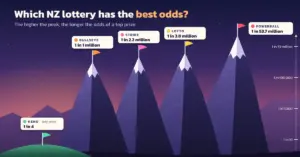
The easiest prize to win is the lowest tier, the new Division 8, which pays a fixed $12 and has the shortest odds of any Powerball division. Division 1 has the longest odds, at about 1 in 53.7 million per line. The lower the division, the better the odds and the smaller the prize.
When is the next Powerball Must Be Won draw?
There is no fixed date. A Must Be Won draw is only called when the Division 1 jackpot climbs to the $60 million cap, which happens after a long run of draws with no top-prize winner. Lotto NZ announces it in advance once the jackpot is set to reach the ceiling.