Lotto divisions in New Zealand decide exactly how much a ticket is worth once the winning numbers are drawn, and they are the reason a draw is never a simple “win or lose” result. Lotto NZ (the trading name of the New Zealand Lotteries Commission) splits every game into tiers, and your prize depends on how many numbers you match and whether you added Powerball or Strike. This guide breaks down the full prize and odds structure for standard Lotto, Powerball, Strike, Keno and Bullseye, including the major Powerball changes that took effect on 13 September 2026, so you can read any ticket with confidence.
Key Points
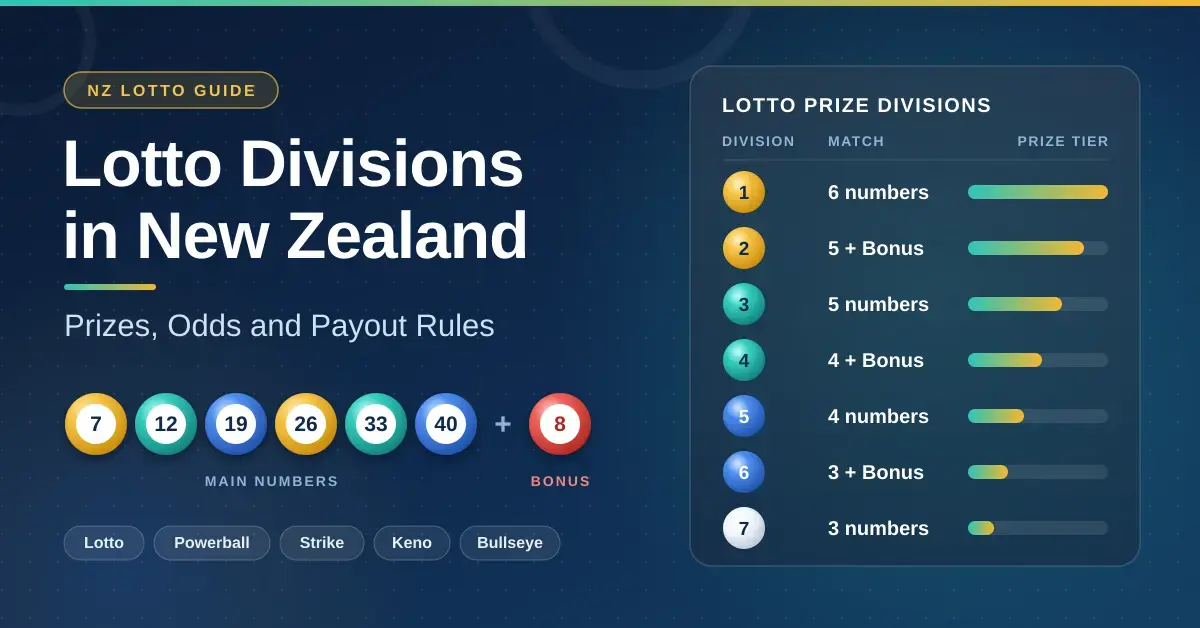
- Seven standard Lotto divisions: from six numbers (Division 1) down to three numbers (Division 7), which pays four free lines.
- The bonus ball is an upgrade, not a pick: it only lifts lines already matching three, four or five main numbers into a higher tier.
- Powerball now has eight divisions: since 13 September 2026 the pool is 1–14, Division 1 odds are 1 in 53,737,320, and the jackpot runs from $5m to a $60m cap.
- New Powerball Division 8: two numbers plus the bonus ball and Powerball pays a fixed $12; Division 7 rose to $20.
- Top tiers are pari-mutuel: higher-division prizes are shared pools, so the per-winner amount changes every draw.
- All winnings are tax-free and must be claimed within 12 months of the draw.
How Lotto divisions work in New Zealand
A division is simply a prize tier, and each tier is defined by a specific combination of matching numbers. In standard Lotto there are seven divisions; adding Powerball opens a parallel set of divisions, and Strike, Keno and Bullseye each run their own separate tables. Knowing which division a ticket falls into tells you both the odds of getting there and how the prize is calculated.
Pari-mutuel pools versus fixed prizes
The single most important idea is the difference between pari-mutuel and fixed prizes. In a pari-mutuel tier, Lotto NZ puts a set share of that draw’s ticket sales into a pool and then divides it equally among all winning lines nationwide, so the amount per winner falls when more people win. The top divisions work this way, which is why a headline figure is only ever an average. Lower divisions are fixed: they pay the same cash amount regardless of how many people win that draw. Understanding this stops the common disappointment of expecting a fixed figure from a shared pool.
Standard Lotto prize divisions and odds
Standard Lotto draws six main numbers from a pool of 40, followed by a single bonus ball. Your result depends entirely on how many of those first six numbers appear on a single line. Division 1 needs all six and pays a $1 million prize pool (shared if there is more than one winner), while the lower tiers offer far more achievable targets. The table below shows the published odds per line and indicative prizes; the lower-division cash amounts are set figures, and Division 7 always pays four free Lotto lines rather than cash.
| Division | Numbers matched | Odds per line | Typical prize (NZD) |
|---|---|---|---|
| Division 1 | 6 main numbers | 1 in 3,838,380 | $1,000,000 (shared pool) |
| Division 2 | 5 main numbers + bonus ball | 1 in 639,730 | Around $20,000 (shared pool) |
| Division 3 | 5 main numbers | 1 in 19,386 | Around $600 (shared pool) |
| Division 4 | 4 main numbers + bonus ball | 1 in 7,754 | Around $55 |
| Division 5 | 4 main numbers | 1 in 485 | Around $30 |
| Division 6 | 3 main numbers + bonus ball | 1 in 363 | Around $22 |
| Division 7 | 3 main numbers | 1 in 35 | 4 free Lotto lines |
For a deeper look at how these tiers are funded and split, see our explainer on Lotto division prizes.
What the bonus ball actually does
The bonus ball is not a number you choose, and it never wins a prize on its own. It is a seventh ball drawn after the first six main numbers, and it only matters if a line already matches exactly three, four or five main numbers. When that happens, the bonus ball lifts the line into a higher division. In practice it acts as a selective upgrade between neighbouring tiers:
- Five numbers: five main numbers alone is Division 3 (around $600). Add the bonus ball and the line jumps to Division 2, which typically pays around $20,000.
- Four numbers: four main numbers is Division 5 (about $30). With the bonus ball it becomes Division 4, roughly doubling the return.
- Three numbers: three main numbers alone is Division 7 (four free lines). Three plus the bonus ball becomes Division 6, worth about $22 in cash.
- No effect at the extremes: the bonus ball cannot change Division 1 (which already needs all six numbers) or the three-number Division 7 result.
Powerball divisions after the 13 September 2026 changes
Powerball changed significantly on 13 September 2026, and any older guide is now out of date. Powerball is an optional add-on that costs $0.80 per line and is drawn from a separate machine. From that date the Powerball pool expanded from numbers 1–10 to 1–14, the starting jackpot rose from $4 million to $5 million, and the maximum jackpot rose from $50 million to $60 million. A new Powerball Division 8 was introduced, and the Division 7 prize increased from $15 to $20. The trade-off is that the top prize is now harder to win: the odds of Powerball Division 1 lengthened from about 1 in 38.4 million to 1 in 53.7 million per line. You can read more about the odds of winning Powerball and how the add-on works on our dedicated Powerball page.
Each Powerball division mirrors a Lotto division plus the matching Powerball number. The figures below reflect the current 14-ball format. Divisions 7 and 8 are fixed; the higher tiers are averages that vary with sales and winner numbers.
| Powerball division | What you match | Odds per line | Typical prize (incl. Lotto win) |
|---|---|---|---|
| Division 1 | 6 numbers + Powerball | 1 in 53,737,320 | Jackpot from $5m, capped at $60m |
| Division 2 | 5 numbers + bonus + Powerball | 1 in 8,956,220 | Around $45,000 |
| Division 3 | 5 numbers + Powerball | 1 in 271,401 | Around $1,400 |
| Division 4 | 4 numbers + bonus + Powerball | 1 in 108,560 | Around $130 |
| Division 5 | 4 numbers + Powerball | 1 in 6,785 | Around $70 |
| Division 6 | 3 numbers + bonus + Powerball | 1 in 5,089 | Around $50 |
| Division 7 | 3 numbers + Powerball | 1 in 493 | $20 + 4 free Lotto lines |
| Division 8 | 2 numbers + bonus + Powerball | 1 in 657 | $12 (fixed) |
Lotto Strike divisions
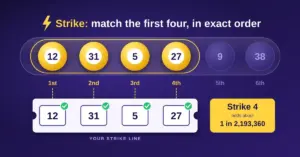
Strike is a separate add-on that costs $1.00 per line and is about order, not just matching. You try to predict the first four main balls in the exact sequence they are drawn, so position matters. There are four tiers, with fixed prizes for the lower ones and a rolling jackpot at the top:
- Strike Four (1 in 2,193,360): all four numbers in the exact drawn order. This is a rolling jackpot that builds until it is struck, capped at a $1.5 million Must-Be-Won level.
- Strike Three (1 in 15,232): three of the first four balls in their correct positions, paying an average of roughly $668.
- Strike Two (1 in 274): two of the first four balls in the correct positions, worth around $67 on average.
- Strike One (1 in 11): one ball in its correct position, rewarded with a free Strike line for the next draw.
You can check the latest draws on our Lotto Strike results page.
Keno prize divisions
Keno runs on an entirely different matrix and draws four times a day. There are 80 numbers in the pool and 20 are drawn each game. You choose how many numbers to play — from 1 up to 10, called the Spot — and the minimum stake is $1 per line. Your prize depends on how many of your chosen numbers match the 20 drawn. A 10-Spot game chasing the top $250,000 prize is the most dramatic example; its $1-line prize ladder looks like this:
| Numbers matched (of 10) | Prize on a $1 line |
|---|---|
| 10 | $250,000 |
| 9 | $20,000 |
| 8 | $500 |
| 7 | $50 |
| 6 | $5 |
| 5 | $2 |
| 0 | $3 |
Matching all ten numbers is roughly a 1-in-8.9-million chance, but because a 10-Spot ticket also pays for matching none, the chance of winning some prize in that game is about 1 in 9. Prizes scale with your stake, so a $2 line doubles the amounts shown above. See the latest draws on our Keno results page.
Bullseye divisions
Bullseye is Lotto NZ’s daily number game, and its divisions are not based on balls in a drum. You pick a six-digit number between 000000 and 999999, and Division 1 requires an exact match of the winning number, paying a jackpot that starts at $100,000 and rolls over each day it is not struck. The lower divisions award smaller fixed cash prizes for landing close to the winning number, scaling down to a $2 bottom tier. Because the exact tier values are set by Lotto NZ and change from time to time, always confirm the current Bullseye prize table before you play rather than relying on older figures.
Game Comparison
| Game | Price per line | What you pick | Top prize | Draw frequency |
|---|---|---|---|---|
| Lotto | $0.70 | 6 numbers from 40 | $1,000,000 (Division 1) | Wednesday & Saturday |
| Powerball | $0.80 | Lotto line + 1 Powerball (1–14) | $5m–$60m jackpot | Wednesday & Saturday |
| Strike | $1.00 | First 4 balls in exact order | Up to $1.5m (Strike Four) | Wednesday & Saturday |
| Keno | From $1.00 | 1–10 numbers from 80 | $250,000 (10-Spot, $1 line) | Four times daily |
| Bullseye | From $0.30 | 6-digit number | Jackpot from $100,000 | Daily |
Must-Be-Won draws and roll-downs
A Must-Be-Won draw changes the normal rules when the Powerball jackpot hits its $60 million cap. Usually, if nobody matches Division 1, the jackpot simply rolls over to the next draw. Once the cap is reached, the money must legally be paid out that night. If no line matches all six numbers plus the Powerball, a roll-down is triggered: the jackpot bypasses the empty top tier and moves down to the next division that has winners.
In practice the pool almost always lands in Powerball Division 2, turning a prize that would normally be around $45,000 into a share of millions for the handful of players who match it. If Division 2 were also empty, the funds would cascade further down. The money is always split equally among every winning line in whichever division inherits it. A Powerball Must-Be-Won roll-down affects only the Powerball pool; the standard $1 million Lotto Division 1 prize is separate and is unaffected. Strike and Bullseye run their own Must-Be-Won draws on the same principle.
Claiming prizes and tax on winnings
All New Zealand lottery winnings are paid out tax-free, because lottery prizes are not treated as income under New Zealand tax law. That applies to every Lotto, Powerball, Strike, Keno and Bullseye division. You can read more about whether you pay tax on Lotto in our dedicated guide.
How prizes are claimed
How you collect depends on the size of the prize and whether you played in store or online:
- Smaller prizes: cash prizes up to $1,000 can be paid out at a Lotto retailer. If you played through MyLotto, the amount is credited to your online wallet automatically after the draw is confirmed.
- Mid-size prizes: larger amounts are generally paid by bank transfer, with online winners completing a verification step linked to their account.
- Major and Division 1 prizes: top-tier wins require a formal prize claim submitted to Lotto NZ, and physical tickets must be validated directly by Lotto NZ rather than at a store.
- Claim deadline: prizes must be claimed within 12 months of the draw date before the ticket expires, so check tickets promptly.
Common mistakes people make about Lotto divisions
Most confusion comes from a handful of recurring misunderstandings. Clearing these up makes every ticket easier to read:
- Thinking the bonus ball is a number you pick: it is drawn automatically and only upgrades lines that already match three, four or five main numbers.
- Expecting a win from the Powerball alone: matching the Powerball number by itself pays nothing. Even the new Division 8 needs two main numbers and the bonus ball alongside the Powerball.
- Assuming a division always pays the same: the top divisions are pari-mutuel, so the per-winner amount changes every draw with sales and winner numbers.
- Using an outdated Powerball guide: since 13 September 2026 the odds, jackpot range and division count have all changed, so older tables are wrong.
- Believing a system improves your odds: the balls are drawn at random and audited, so no pattern, hot number or strategy changes the mathematical odds of any division.
Responsible gambling
Lotto products are games of chance, and the odds of the upper divisions are very long — Powerball Division 1 is 1 in 53.7 million per line. There is no skill, system or technique that changes which numbers are drawn, so tickets should only ever be bought with money set aside for entertainment. You must be 18 or over to buy Lotto NZ products. Set a firm weekly limit and treat any win as a bonus rather than an expectation. If gambling is causing stress for you or someone close to you, free and confidential help is available 24/7 from the Gambling Helpline on 0800 654 655, and you can also read our responsible gambling page.
Sources
- Lotto NZ – More Powerballs, more prizes coming 13 September
- Lotto NZ – How to play Lotto, Powerball and Strike
- NZ Herald – Lotto NZ announces overhaul of Powerball rules
- Stuff – Powerball odds get longer as Lotto NZ adds four more balls
- 1News – Lotto’s top prize to hit $60m but it’s never been harder to win
- New Zealand Legislation – Lotto Amendment Rules 2026
- New Zealand Legislation – Keno Rules 2025
Frequently Asked Questions
How many Lotto divisions are there in New Zealand?
Standard Lotto has seven divisions, from a six-number match in Division 1 down to a three-number match in Division 7. Adding Powerball opens a parallel set of divisions, which expanded to eight tiers after the 13 September 2026 changes.
What changed with Powerball on 13 September 2026?
The Powerball pool grew from numbers 1–10 to 1–14, which lengthened Division 1 odds from about 1 in 38.4 million to 1 in 53.7 million per line. The jackpot now starts at $5 million and caps at $60 million, a new Division 8 pays a fixed $12, and Division 7 rose from $15 to $20. The price stayed at $0.80 per line.
What do you win for matching three numbers in Lotto?
Matching exactly three main numbers lands you in Division 7, which pays four free Lotto lines for the next draw rather than cash. If you also match the bonus ball, the line moves up to Division 6, worth about $22.
Are Lotto division prizes taxed in New Zealand?
No. All Lotto, Powerball, Strike, Keno and Bullseye prizes are paid out tax-free, because lottery winnings are not treated as income under New Zealand tax law. There is nothing to declare to Inland Revenue.
What happens to the divisions in a Must-Be-Won draw?
When the Powerball jackpot reaches its $60 million cap and nobody matches Division 1, the prize rolls down to the next division that has winners — usually Division 2 — and is split equally among those lines. The standard Lotto Division 1 prize is separate and is not affected.