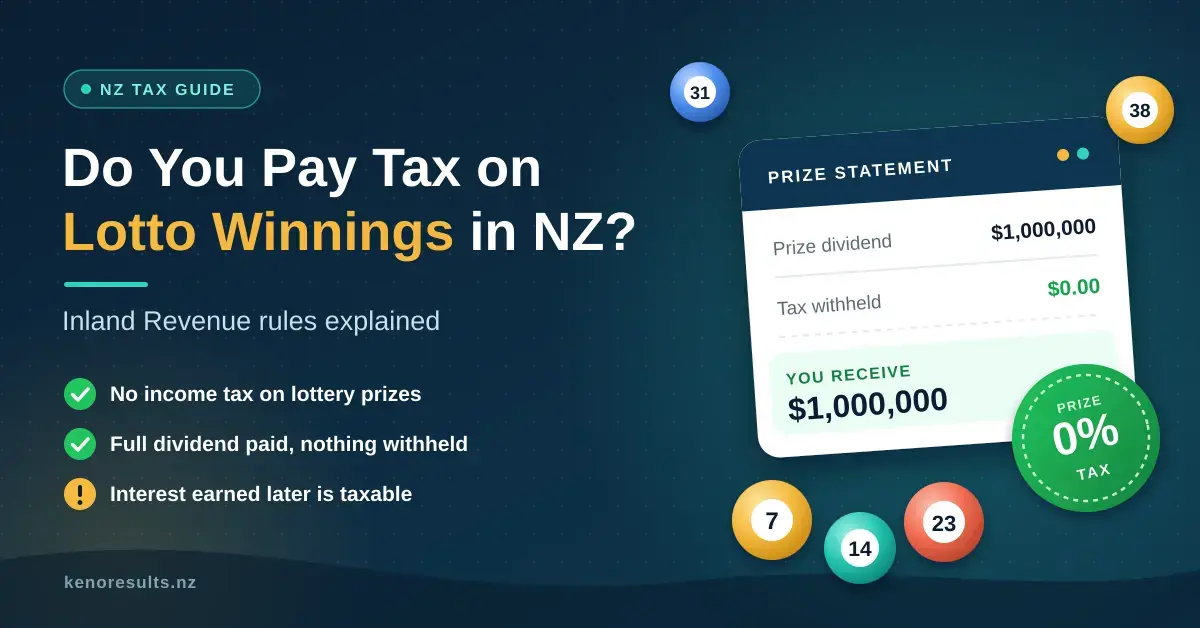
No, you do not pay income tax on Lotto, Powerball, Strike, Keno or Bullseye prizes in New Zealand. Inland Revenue (IRD) treats a lottery prize as a windfall gain rather than earned income, so the full advertised dividend lands in your bank account with nothing withheld. This is very different from countries such as the United States, where tax is deducted before a winner is paid. The tax-free status applies to the prize itself; what you do with the money afterwards — earning interest, buying rental property or investing — can create ordinary tax obligations. This guide explains the IRD rules in plain language, verified against Inland Revenue and official sources, and reflects the Powerball format changes that took effect on 13 September 2026.
Key Points
- No income tax on prizes. IRD treats Lotto, Powerball, Strike, Keno and Bullseye wins as non-taxable windfalls.
- You keep 100%. Nothing is withheld at payout — you receive the full advertised dividend.
- Interest is taxable. Resident Withholding Tax applies once the money earns interest in a bank account.
- No general capital gains tax, but the two-year bright-line rule can tax profit on investment property.
- No gift duty. Abolished on 1 October 2011, so you can share winnings tax-free.
- Tax is collected at the source. Lotto NZ pays a 5.5% lottery duty plus GST, so winners are not taxed.
Are Lotto winnings taxed in New Zealand?
Lotto winnings are not taxed in New Zealand because Inland Revenue does not classify casual gambling prizes as assessable income. Money from a raffle, a Lotto draw or a prize draw is a windfall — a one-off stroke of luck — rather than a salary, business profit or dividend. Casual play lacks the structure, regular intent and commercial organisation of a profession, so it cannot be assessed under PAYE (Pay As You Earn, the tax deducted from wages) or provisional tax.
The result is simple: the entire face value of your prize is yours. This applies equally across the standard Lotto divisions, Powerball jackpots, Strike, and the daily Keno and Bullseye games, whether you bought the ticket at a dairy or through the official New Zealand Lotteries Commission MyLotto platform. The purchase channel makes no difference to the tax treatment.
Which prizes are tax-free windfalls?
The table below shows how different payouts are treated. The clear dividing line is between a one-off prize and the income that money later generates.
| Payout source | Tax withheld at payout | Counted as taxable income | Must be declared to IRD |
|---|---|---|---|
| Standard Lotto draw | None | No | No |
| Powerball jackpot | None | No | No |
| Strike, Keno or Bullseye | None | No | No |
| Interest earned on the winnings | Yes (RWT) | Yes | Yes (handled by your bank) |
| Rental income from property bought with winnings | No | Yes | Yes |
Why New Zealand does not tax your prize
New Zealand keeps prizes tax-free because it collects revenue from the lottery at the operator level, not from the winner. Several charges apply before any prize is paid, which is why the government still benefits from every ticket sold even though winners keep 100% of their dividend.
Lotto NZ pays a lottery duty of 5.5% on the nominal value of all tickets in a game, paid directly to the Crown under the Gaming Duties Act 1971. On top of that, Goods and Services Tax (GST) applies to gambling: under the GST Act the money paid to enter a New Zealand lottery is treated as payment for a service, and GST at the standard 15% rate falls on the proceeds (the amount staked after prizes are deducted). Lotto NZ also pays a problem gambling levy. Because tax is built into the system at the point of sale, there is no need to tax the winner at the point of payout.
Where each lottery dollar goes
The money from ticket sales is split between prizes, community funding, taxes and running costs. The figures below are approximate and move with sales and the prize pool rules.
| Where the money goes | Approximate share | Purpose |
|---|---|---|
| Player prize pool | At least 55% of turnover | Division payouts across all games (minimum set by the Lotto rules from 13 September 2026, down from 60%) |
| Lottery Grants Board | Operating profit | Funding for sport, arts, heritage and community groups via the Grants Board |
| GST | 15% on proceeds | Collected into general Crown accounts |
| Lottery duty | 5.5% of ticket value | A dedicated gaming tax paid by Lotto NZ |
| Retail and operating costs | Remainder | Retailer commissions and running the games and MyLotto platform |
Tax on interest: Resident Withholding Tax (RWT)
The one tax most winners will meet is on the interest their prize earns, not on the prize itself. The moment a tax-free windfall is deposited into an interest-bearing account at a bank such as ANZ, ASB, BNZ or Westpac, it enters the ordinary banking system, and any interest it generates is fully taxable income.
New Zealand banks are legally required to deduct Resident Withholding Tax (RWT) — tax taken from interest before it is paid to you — and pass it to Inland Revenue. The rate depends on your total annual income, running through bands of 10.5%, 17.5%, 30%, 33% and a top rate of 39% for income over $180,000. With a multi-million-dollar balance, interest alone can push a winner into that top band, so the correct rate matters.
Setting the right RWT rate and common mistakes
Getting your RWT rate right avoids both nasty surprises and over-payment. The key points are below.
- Give your bank your IRD number. If you do not, the bank must apply the no-notification rate of 45% — higher than any ordinary band.
- Choose a rate; do not rely on the default. If you supply an IRD number but pick no rate, a default of 33% applies, which may be too low or too high for your situation.
- Expect a large interest figure. A $20 million windfall in a 5% term deposit earns about $1 million of gross interest a year, almost all of it taxed at the top 39% rate.
- Let the bank do the admin. The bank calculates and forwards RWT to Inland Revenue for you, and your tax position is squared up at year-end.
Is there a gift tax when you share your winnings?
No. New Zealand abolished gift duty on 1 October 2011, so you can give any amount of your tax-free winnings to family, whānau or friends without either party owing tax on the gift. Paying off a relative’s mortgage, setting up a fund for grandchildren or helping a friend clear debt all carry no gift tax.
Although no duty applies, documenting large transfers prevents complications down the track, especially with banks and lenders.
Documenting large gifts
- Use a deed of gift. A simple, formal deed proves to a recipient’s bank that a large incoming transfer is a genuine present, not undeclared income or a loan.
- Help first-home buyers with a gift letter. Mortgage lenders usually require a signed letter confirming the money is a gift that does not need to be repaid.
- The recipient owes no tax. Because the cash comes from a tax-free windfall and is not an employment bonus or business payment, the person receiving it has nothing to report to Inland Revenue.
- Consider professional advice for very large gifts. Family trusts and estate planning can help manage wealth across generations and should be set up with a qualified lawyer.
Property, investments and capital gains
New Zealand has no general capital gains tax, so an increase in the value of your own family home over time is not taxed. Buying or upgrading the home you live in with your winnings has no tax consequence on any later gain, because the main-home exclusion applies.
Investment property is treated differently. If you use your windfall to become a residential property investor, you need to be aware of the bright-line property rule and of tax on rental income.
The bright-line property rule explained
The bright-line rule taxes the profit on residential investment property sold within a set period, acting as a targeted capital gains tax.
- Two-year window. For property sold on or after 1 July 2024, the test applies if you sell within two years of acquiring it; any gain is taxed at your normal income tax rate.
- Main home excluded. Your primary residence is generally exempt, provided you use more than half the area as your home and live in it for more than half the time you own it.
- Rental income is taxable. Rent you collect from tenants is assessable income and must be declared each year, whether or not the bright-line rule applies.
- Get advice. Property tax rules change often, so a registered accountant helps keep a portfolio compliant.
When could a lottery win become taxable?
A lottery or gambling return can only become taxable in the rare case where the activity stops being a hobby and becomes an organised business. For the vast majority of players buying a ticket for fun, this never happens.
If a person or company runs a highly structured operation — using specialised software, staff, offices and significant capital to systematically exploit betting markets for profit — Inland Revenue can treat the activity as a taxable business, making the proceeds business income. The signs IRD looks for include commercial bookkeeping, employees and corporate structures. Buying a Power Dip or a Triple Dip when the jackpot climbs is universally recognised as recreation and keeps your winnings firmly tax-free. Keeping personal play separate from any business accounts preserves that status.
How New Zealand compares with overseas lottery taxes
New Zealand sits with Australia and the United Kingdom among countries that do not tax lottery prizes, in sharp contrast to the United States. In the US, prizes are ordinary income: the IRS withholds a flat 24% on large wins immediately, and the final bill can reach the top federal rate of 37%, before state income taxes of up to roughly 10% are added. A US winner of a headline jackpot can end up with little more than half the advertised figure. Spain takes a different approach again, applying a 20% tax only to the portion of a prize above a €40,000 exemption. The comparison below summarises the main jurisdictions.
Comparison
| Country | Tax withheld from the prize | Regional / state tax | What a winner typically keeps |
|---|---|---|---|
| New Zealand | None (tax-free windfall) | None | 100% of the dividend |
| Australia | None (tax-free windfall) | None | 100% of the dividend |
| United Kingdom | None (tax-free windfall) | None | 100% of the dividend |
| United States | 24% withheld, up to 37% at filing | Variable (0% to about 10%) | Roughly 50–60% of the prize |
| Spain | 20% on the amount above a €40,000 exemption | None | Full prize up to €40,000, then 80% of the rest |
First steps after a major win
A life-changing win brings administrative and emotional pressure as well as freedom, so a calm plan matters more than quick decisions. Because the money arrives intact and tax-free, the responsibility of managing millions can feel overwhelming without support.
Lotto NZ gives major winners a “Winners’ Book” with practical guidance for the first weeks. The consistent advice is to pause, keep the news to a small circle of trusted people, and avoid big lifestyle changes until a professional team is in place. If you are still at the ticket stage, understanding how to claim Lotto winnings in NZ and how the Lotto prize divisions work helps you know exactly what you are entitled to.
Building a professional team
- Independent financial adviser. A fee-only adviser registered with the Financial Markets Authority (FMA) can build a diversified plan around your goals.
- Registered accountant. An accountant manages your RWT settings, any trusts and your annual Inland Revenue reporting.
- Lawyer. A lawyer can update your will, set up enduring powers of attorney and draft deeds of gift for family distributions.
- Patience. Parking the funds in a secure short-term account for a few months buys time to make rational decisions.
Common tax mistakes winners make
Most tax problems after a win come from what happens to the money, not the prize. The frequent mistakes are easy to avoid once you know them.
- Forgetting the IRD number step and being charged the 45% no-notification RWT rate on interest.
- Assuming everything stays tax-free — interest, rental income and dividends are all taxable even though the prize was not.
- Overlooking the bright-line rule when flipping an investment property within two years.
- Mixing personal play with business accounts, which can blur the line between a hobby and a taxable activity if you run syndicates at scale. See the rules for a Lotto syndicate if you play as a group.
- Treating the lottery as an investment. With Powerball odds now 1 in 53.7 million for Division 1, tickets are entertainment, not a savings plan.
Disclaimer
This article is general information about New Zealand tax rules and is not financial, tax or legal advice. Tax treatment depends on your personal circumstances; confirm your position with Inland Revenue or a registered adviser before acting. Lottery games such as Powerball are based on random chance and no system can improve your odds — only ever spend within an entertainment budget you can afford to lose. If gambling is causing harm for you or someone you know, free and confidential help is available 24/7 from the New Zealand Gambling Helpline on 0800 654 655, by texting 8006, or at gamblinghelpline.co.nz. You must be 18 or over to buy a ticket.
Sources
- Inland Revenue — Lottery duty
- Inland Revenue — Resident Withholding Tax (RWT)
- Inland Revenue — The bright-line property rule
- Inland Revenue — Gift duty abolition (2011)
- New Zealand Legislation — Lotto Amendment Rules 2026
- 1News — Powerball top prize to hit $60m and odds change
- Gambling Helpline New Zealand
Frequently Asked Questions (FAQ)
Do you pay tax on Lotto winnings in NZ?
No. Inland Revenue treats Lotto, Powerball, Strike, Keno and Bullseye prizes as non-taxable windfall gains, so you receive the full advertised dividend with no income tax or withholding taken out.
Does the IRD tax a win bought online through MyLotto?
No. The purchase channel does not change the rules. A ticket bought on the MyLotto app or website is treated exactly the same as a paper ticket from a dairy, and the prize is tax-free either way.
Do I pay tax if I put my winnings in a term deposit?
The lump sum stays tax-free, but any interest it earns is taxable. Your bank automatically deducts Resident Withholding Tax from the interest. Give the bank your IRD number and choose the correct rate to avoid the 45% no-notification rate.
Is there a gift tax if I share my winnings with family?
No. Gift duty was abolished in New Zealand on 1 October 2011, so you can gift any amount of your winnings to family, whānau or friends with no tax for either party. A simple deed of gift is still useful for documentation.
Do I need to declare a lottery prize on my tax return?
No. A casual lottery prize does not meet the definition of assessable income, so it is not listed on your annual return. You only declare the income your winnings later generate, such as interest or rent.