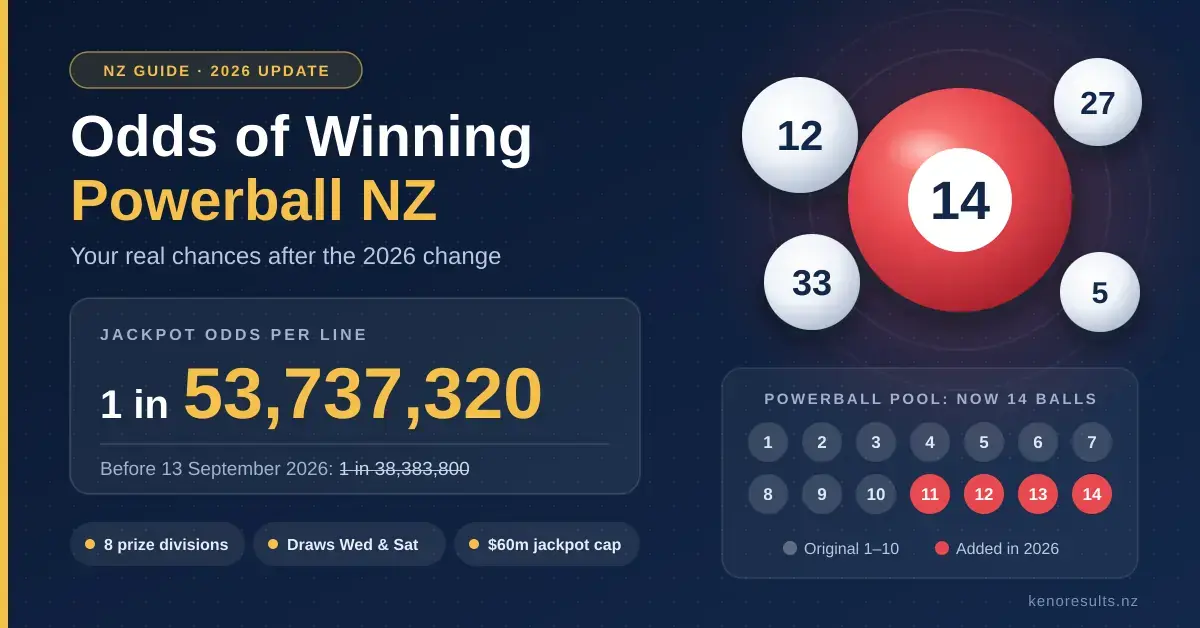
The odds of winning the Powerball jackpot in New Zealand are now 1 in 53,737,320 per line — the figure that applies to every draw held since the game was overhauled on 13 September 2026. If you last checked before that date, the number you may remember (1 in 38,383,800) is out of date. This guide explains the current mathematics behind every Powerball in New Zealand prize division, what the September 2026 change did to your chances, and the facts that marketing around big jackpots tends to leave out.
Key Facts
| Game | Lotto Powerball (New Zealand) |
| Change effective | 13 September 2026 (first draw 16 September 2026) |
| Powerball pool | 14 balls (numbered 1–14), up from 10 |
| Jackpot (Division 1) odds | 1 in 53,737,320 per line |
| Jackpot range | Starts at $5 million, capped at $60 million (Must Be Won) |
| Prize divisions | 8 (new Division 8 added) |
| Cost | $0.80 per line on top of a $0.70 Lotto line ($1.50 combined); minimum 4 lines |
| Draw days | Wednesday and Saturday |
How likely are you to win Powerball in New Zealand?
On a single line, your chance of winning the top Powerball prize (Division 1) is 1 in 53,737,320. Because a standard entry must contain at least four lines, a basic $6.00 ticket gives you a combined jackpot chance of about 1 in 13,434,330. Lower divisions are far more reachable: the easiest tier, Division 7, comes up roughly once every 493 lines.
These numbers are fixed by the mechanics of the game, not by where or how you buy. A ticket bought on the MyLotto app, at a supermarket kiosk in Auckland or at a small-town dairy carries exactly the same odds. No system, pattern or lucky store changes them.
What changed in the September 2026 Powerball update?
From Sunday 13 September 2026, Lotto NZ added four extra Powerballs to the draw, expanding the Powerball pool from ten numbers (1–10) to fourteen (1–14). The first draw under the new rules took place on Wednesday 16 September 2026. The main Lotto draw — six numbers plus a bonus ball from a pool of 40 — did not change.
- Longer odds: the Division 1 jackpot moved from 1 in 38,383,800 to 1 in 53,737,320 per line.
- Bigger jackpots: the starting jackpot rose from $4 million to $5 million, and the Must Be Won cap rose from $50 million to $60 million.
- A new Division 8: an eighth prize tier was added, paying a fixed $12.
- A higher fixed prize: Division 7 increased from $15 to $20.
- Same price: Powerball still costs an extra $0.80 per line.
Lotto NZ projected around 30% more Powerball winners each week across all divisions, while Division 1 itself would be struck less often — the operator estimated a $60 million Must Be Won draw roughly every two to two-and-a-half years. Those are projections made at launch, not confirmed results.
Why your chances got slightly longer
Adding four Powerballs changed only the second part of the draw. Your chance of picking the single correct Powerball fell from 1 in 10 to 1 in 14. Because that step multiplies the main-draw odds, every existing Powerball division became exactly 1.4 times harder. The main six-number Lotto odds (1 in 3,838,380) were untouched, which is why the odds of winning standard Lotto stayed the same.
How the two-drum draw actually works
Winning the Powerball jackpot means beating two separate draws on the same line. The first is the main Lotto machine, which holds 40 balls and selects six main numbers plus one bonus ball. The second is the Powerball machine, which now holds 14 balls and selects a single Powerball.
Matching all six main numbers from the 40-ball draw has odds of 1 in 3,838,380 on its own. Powerball is an optional add-on that costs $0.80 a line; you cannot play it without also playing Lotto. When you add it, your line must also match that one Powerball number to reach Division 1.
The Powerball multiplier
Because the Powerball is drawn from its own pool, it acts as a straight multiplier on the main odds. With 14 balls, the chance of matching it is 1 in 14, so the jackpot odds become 3,838,380 × 14 = 53,737,320. Under the old ten-ball pool the multiplier was 10, which is why the jackpot was previously 1 in 38,383,800.
Powerball prize divisions and their odds
There are now eight Powerball divisions, each tied to a specific combination of main numbers, the bonus ball and the Powerball on one line. The odds below are per line and apply to every draw from 16 September 2026 onward.
Powerball Divisions
| Division | Match on one line | Odds per line | Prize |
|---|---|---|---|
| Division 1 | 6 main + Powerball | 1 in 53,737,320 | Jackpot ($5m start, $60m cap) |
| Division 2 | 5 main + bonus + Powerball | 1 in 8,956,220 | Pool share (varies) |
| Division 3 | 5 main + Powerball | 1 in 271,401 | Pool share (varies) |
| Division 4 | 4 main + bonus + Powerball | 1 in 108,560 | Pool share (varies) |
| Division 5 | 4 main + Powerball | 1 in 6,785 | Pool share (varies) |
| Division 6 | 3 main + bonus + Powerball | 1 in 5,089 | Pool share (varies) |
| Division 7 | 3 main + Powerball | 1 in 493 | $20 fixed |
| Division 8 | 2 main + bonus + Powerball | 1 in 657 | $12 fixed |
Only some prizes are fixed. Division 7 ($20) and Division 8 ($12) pay set amounts, and Division 1 is the jackpot, starting at $5 million and capped at $60 million. Divisions 2 to 6 are pari-mutuel — a share of the pool set aside for that tier, split among the winning lines — so the dollar amount changes with every draw and depends on how many people win. For a wider breakdown of how the pools are split, see the guide to Lotto prize divisions.
Does buying more lines improve your odds?
Buying more lines improves your odds in direct proportion to how many lines you play, and nothing more. Each extra line is one more independent chance against the same 53.7-million-to-one wall, so the headline probability barely moves.
- 4 lines (a $6.00 base entry): about 1 in 13,434,330.
- 10 lines: about 1 in 5,373,732.
- 20 lines: about 1 in 2,686,866.
- 40 lines: about 1 in 1,343,433.
Even spending $60 on 40 lines leaves you with worse than a one-in-a-million chance of the jackpot. Spending more does raise your odds of a small lower-division prize, but it never turns a lottery into a sensible investment. Before buying extra lines it is worth checking how much a Lotto ticket costs so the spend stays deliberate.
Do your own numbers win more often than a Lucky Dip?
No. Hand-picked numbers and a computer-generated Lucky Dip have identical odds, because the machines have no idea how your numbers were chosen. The sequence 4, 12, 19, 23, 31, 37 with Powerball 5 is exactly as likely as 1, 2, 3, 4, 5, 6 with Powerball 1.
The real difference: sharing a jackpot
Selection method does not change your chance of winning, but it can change how much you keep if you do. Many players pick birthdays, which use only the numbers 1–31, and favour neat patterns on the coupon. If a popular combination wins, the pari-mutuel pool is split among more people, shrinking each share. Choosing less common numbers (including those above 31) will not help you win, but it can reduce the risk of splitting a prize. Curious which balls appear most? See the data on the most common Powerball numbers.
How a “Must Be Won” draw and roll-down work
When the jackpot reaches its $60 million cap and no one wins Division 1, the prize cannot keep rolling over — it “must be won” that night. If no line matches all six main numbers plus the Powerball, the jackpot rolls down to the next division that has winners, usually Powerball Division 2.
In a roll-down, the whole top-tier pool is shared equally among the winning lines in the division that inherits it, which can turn a typical mid-tier prize into a multi-million-dollar payout for a handful of players. Two things do not change: the roll-down applies only to the Powerball pool (the separate Lotto First Division still works normally), and the odds of actually matching numbers stay fixed. A Must Be Won draw changes the prize money, never the mathematics.
Where Lotto Strike, Keno and Bullseye fit in
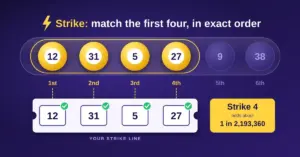
Powerball is not the only draw Lotto NZ runs, and the alternatives have very different odds. Lotto Strike is an add-on costing $1 per line where you predict the first four main balls in the exact order they are drawn; its top prize, Strike Four, is 1 in 2,193,360 per line and the jackpot starts at $200,000. The daily games Keno and Bullseye run on their own schedules and number pools.
| Game | Number pool | Top prize needs | Top-tier odds |
|---|---|---|---|
| Lotto Powerball | 40 main balls + 14 Powerballs | 6 main + 1 Powerball | 1 in 53,737,320 per line |
| Lotto Strike | 40-ball main draw | First 4 balls in exact order | 1 in 2,193,360 per line |
| Daily Keno (10 spot) | 80 numbers, 20 drawn | All 10 chosen numbers | 1 in 8,911,711 |
| Bullseye | Six digits, 000000–999999 | Exact six-digit match | 1 in 1,000,000 |
Bullseye draws every evening and asks you to match a six-digit number exactly for a top prize of 1 in 1,000,000. You can read more about how Bullseye works if a daily game with shorter odds appeals more than a twice-weekly jackpot.
Common mistakes and myths about Powerball odds
The biggest mistakes players make are about psychology, not arithmetic. Keeping these straight protects both your expectations and your budget.
- Chasing “overdue” numbers: a ball that has not appeared for months is no more likely to come up next draw. The machines have no memory.
- Believing big jackpots improve the odds: whether the prize is $5 million or $60 million, the jackpot odds stay 1 in 53,737,320 per line.
- Treating more spend as a strategy: extra lines add chances proportionally but never shift the odds into realistic territory.
- Assuming a “system” beats random: no selection method, app or pattern changes a fair, random draw.
The gambler’s fallacy
The gambler’s fallacy is the belief that past results influence future ones — that a number is “due”. Each Powerball draw is independent, so every number has the same chance every time, regardless of when it last appeared. Random sequences naturally produce short streaks and clusters, which the human brain mistakes for meaningful patterns.
How the draws are kept fair
Lotto NZ draws are run under independent supervision and are regulated in New Zealand by the Department of Internal Affairs. The draw equipment and ball sets are tested and the results audited, which is how the operator demonstrates that outcomes are random and that every number has an equal chance.
What this means for players is simple: there is no exploitable bias to find. Historical “hot” and “cold” streaks are the ordinary product of randomness, not a flaw you can use. Treat any claim that a particular store, time or sequence improves your odds as marketing, not fact.
Responsible play and disclaimer
This article is for information only. It explains the published odds of New Zealand’s Lotto Powerball; it is not advice to play, and no figure here improves anyone’s chance of winning. Powerball is a game of pure chance with a very low probability of a top prize.
You must be 18 or over to buy Lotto products in New Zealand. Only spend what you can comfortably afford to lose, and never use money set aside for rent, bills, food or savings. Warning signs include spending more when a jackpot climbs, hiding how much you play, or arguments about it.
If gambling is causing harm for you or someone you know, free and confidential help is available in New Zealand from the Gambling Helpline on 0800 654 655 (24/7, or text 8006) and at Choice Not Chance.
Sources
- Lotto NZ — Powerball changes (official)
- Lotto NZ — How to play Lotto, Powerball and Strike
- Lotto Amendment Rules 2026 (New Zealand Legislation)
- NZ Herald — Lotto NZ announces Powerball overhaul
- 1News — Why tonight’s Lotto jackpot will be harder to win
- Scoop — More chances to win as Lotto NZ unveils Powerball changes
Frequently Asked Questions (FAQ)
What are the odds of winning Powerball in NZ in 2026?
Since 13 September 2026 the odds of winning the Powerball jackpot (Division 1) are 1 in 53,737,320 per line. This replaced the old figure of 1 in 38,383,800 after four extra Powerballs were added to the draw.
Why did the Powerball odds get harder?
Lotto NZ expanded the Powerball pool from 10 numbers to 14. Your chance of matching the single Powerball dropped from 1 in 10 to 1 in 14, which made every Powerball division 1.4 times harder while the main Lotto odds stayed the same.
What is the easiest Powerball division to win?
Division 7 is the most reachable at about 1 in 493 per line, for matching three main numbers plus the Powerball. It pays a fixed $20. The new Division 8 pays a fixed $12.
Does buying more lines or waiting for a bigger jackpot improve my odds?
More lines raise your chance only in proportion to how many you buy — 40 lines is still worse than one in a million for the jackpot. A bigger jackpot changes the prize, not the odds, which stay fixed per line every draw.
Are the odds different on the MyLotto app versus in a shop?
No. The odds are identical across every channel. Where and how you buy a ticket, and whether you pick your own numbers or take a Lucky Dip, makes no difference to your chance of winning.