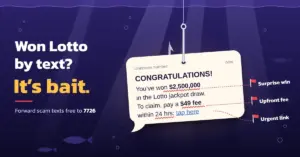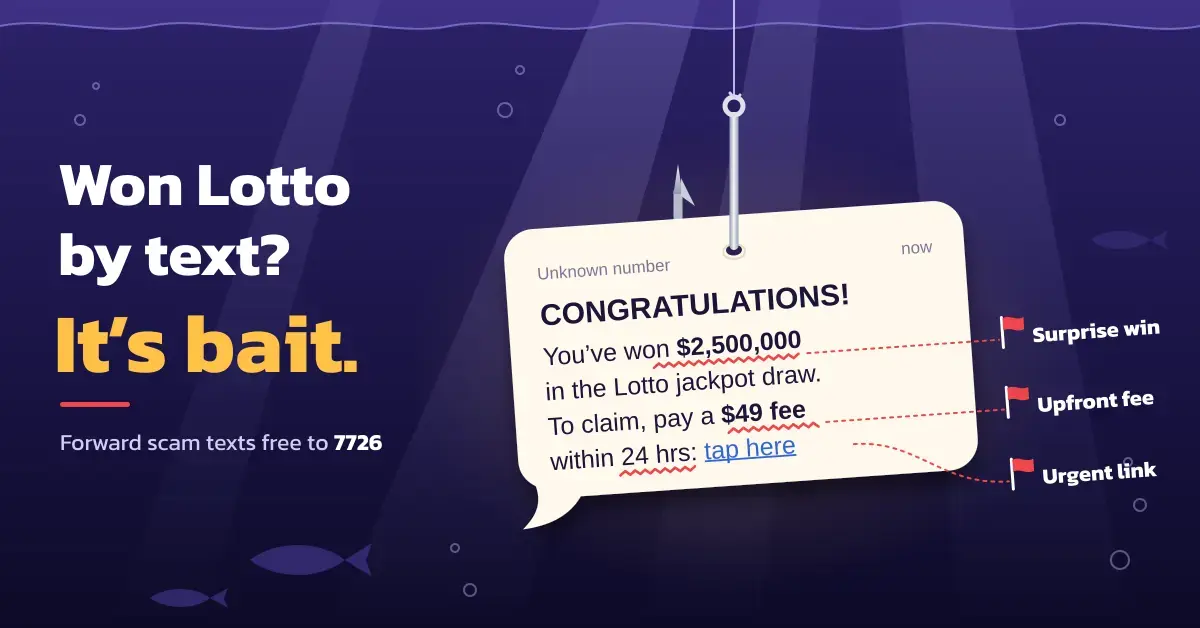
If you get an unexpected text telling you that you have won Lotto, a jackpot share or a cash prize in New Zealand, it is a scam. Real wins do not arrive as a surprise message from an unknown number, and no genuine lottery asks you to pay a fee or hand over card details to release a prize.
Key Facts
- Unsolicited “you’ve won Lotto” texts are scams — you can only win on a ticket you bought.
- Genuine Lotto NZ texts go only to “text to play” subscribers and come from the short number 3361.
- Lotto never charges a fee to release a prize, and Lotto winnings in New Zealand are not taxed.
- Report a scam text free by forwarding it to 7726 (Department of Internal Affairs).
- Get advice or report a loss to Netsafe (0508 638 723 / text 4282) or the National Cyber Security Centre at ncsc.govt.nz/report.
Are “you’ve won Lotto” texts always a scam in New Zealand?
Yes. An unsolicited text claiming you have won Lotto, Powerball, a “jackpot draw” or a share of someone else’s winnings is a scam every time. The reason is simple: in New Zealand you can only win a Lotto prize on a ticket you actually bought, and the operator already knows how to pay you without texting a stranger. A message that announces a win out of the blue, especially for a game you never entered, is the single clearest sign of a fraud.
These messages are common. Security firm Trend Micro reported that lottery and prize scams made up 38% of SMS scam reports across Australia and New Zealand in September 2025. Prize texts are cheap for scammers to send in bulk, so even a small success rate pays off for them.
How does the Lotto winner text scam work?
The scam follows a predictable script designed to create excitement first and pressure second.
The fake prize announcement
You receive a text saying you have won a large sum, been “selected” in a draw, or been chosen to receive money from a recent jackpot winner. The wording often sounds official and may use the word “Lotto”, a reference number, or your suburb to feel personal. In one reported case the message claimed Lotto was looking for specific people in an Auckland suburb and asked them to follow a link.
The upfront fee or “tax”
Once you respond, the scammer says you must pay something before the prize can be released: a processing fee, a “release” charge, insurance, courier costs or tax. This is the heart of almost every lottery scam. A genuine prize is never conditional on you paying money first, and in New Zealand Lotto winnings are not taxed, so any request for a tax payment is proof of a fraud.
The malicious link and data harvesting
Many of these texts include a link. It may lead to a fake website built to look like the real operator, or to a page that asks for your bank details, MyLotto login, passport or driver licence. The goal is to steal your personal and financial information, which can then be used to drain accounts or commit identity fraud. The login address on any message should always be checked against the operator’s real website rather than tapped from the text.
How does Lotto NZ actually contact players?
Lotto New Zealand does not send random texts telling people they have won. Knowing how real communication and prize payments work makes the fakes stand out immediately.
The only Lotto texts most players will ever receive are reminders for the optional “text to play” service, which go only to customers who have subscribed and are sent from the short number 3361. A win notification from a long mobile number, an overseas number or a name you do not recognise is not from Lotto.
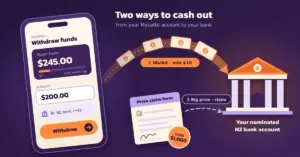
Prizes are paid through the systems you already use, not through a surprise message. If you bought your ticket through your MyLotto account, smaller prizes (currently $1,000 or less) are credited automatically and larger wins require you to complete an online claim form; you can then withdraw your winnings from MyLotto to your bank. Paper tickets are checked and paid at a Lotto retailer, and the biggest prizes are claimed directly with Lotto NZ. For the full process, see our guides on how to claim Lotto winnings in NZ and the official Lotto prize claim form. At no point does any of this involve an unexpected text asking for a fee.
It also helps to know who runs the games. Lotto is operated by a licensed body, the New Zealand Lotteries Commission, and all lotteries sold in New Zealand must be licensed through the Department of Internal Affairs. “Overseas” or “international” lotteries that you supposedly won without entering are not legitimate ways to win money.
How to spot a fake Lotto prize text
Most scam prize texts share the same tells, and setting them beside how a genuine Lotto NZ win works makes the fakes stand out. If a message matches the scam side of even one row below, treat it as a scam.
Genuine Lotto vs Scam Text
| Sign | Genuine Lotto NZ | Scam text |
|---|---|---|
| How you win | On a ticket you bought (in-store or on MyLotto) | A draw or “selection” you never entered |
| Sender | “Text to play” reminders from 3361 only | Unknown mobile, overseas number or display name |
| Fees to claim | None — winnings are paid to you, untaxed | Asks for a fee, tax, insurance or “release” cost |
| Links | No surprise login or payment links by text | Link to a fake site asking for details or payment |
| Tone | No pressure; claim through official channels | Urgent — “claim within 24 hours or lose it” |
| Details requested | Handled through your verified MyLotto account | Wants card numbers, passwords or ID over text |
| Wording and details | Consistent, official wording for a game you entered | The details don’t add up — odd grammar, a prize you were never offered or an unfamiliar “winner” fund |
What should you do if you get a scam Lotto text?
Do not engage with the message at all. Replying, even to say “stop”, tells the scammer your number is active and can lead to more attempts. Take these steps instead:
- Do not reply and do not tap any links. Delete anything you may have already copied.
- Report it free to 7726. Forward the scam text to the short code 7726, run by the Department of Internal Affairs at no charge. You will get an automatic reply asking you to send the number the scam came from; your report is recorded either way. If a message cannot be forwarded, copy the text into a new message to 7726.
- Block the sender on your phone so the same number cannot message you again.
- Report the scam for advice. Netsafe takes scam reports and offers guidance (phone 0508 638 723, text 4282, or report online at report.netsafe.org.nz). Online security incidents, including money lost, can also be reported to the National Cyber Security Centre at ncsc.govt.nz/report, the agency that absorbed CERT NZ in 2025.
- Warn others. A quick heads-up to older or less tech-confident whānau can stop the message working on someone who is less sure.
What if you already clicked the link or paid?
Act quickly if you have already interacted with a scam text. Contact your bank immediately if you entered any card or account details or sent money, so it can freeze cards, watch for fraud and attempt to recover a payment. Change the password on any account whose login you may have exposed, including MyLotto, and turn on two-factor authentication where it is offered. Report the loss to Netsafe and the National Cyber Security Centre, and keep a copy of the message and any payment details for your report. Acting within hours gives the best chance of limiting the damage.
Common mistakes people make with prize-text scams
Even careful people slip up, usually in the same few ways:
- Paying a “small” fee. Once you pay once, scammers invent more fees and chase the loss until you stop.
- Assuming the sender number is genuine. Numbers can be spoofed or hidden behind a display name, so a real-looking sender is not proof.
- Trusting a familiar name or logo. Scammers copy the Lotto name, colours and wording. The look of a message proves nothing.
A note on gambling and scams
This guide is general information about spotting and reporting fake prize messages, not legal, financial or gambling advice. Nothing here is a way to win Lotto or improve your odds; a genuine prize only ever comes from a ticket you bought yourself. If gambling is causing stress for you or someone you know, free and confidential help is available 24/7 from Gambling Helpline Aotearoa on 0800 654 655 or by texting 8006. If you have lost money to a scam, report it to Netsafe and the National Cyber Security Centre and speak to your bank as soon as possible.
Sources
- Department of Internal Affairs — Report TXT Spam (7726)
- Netsafe — Report a scam (0508 638 723 / text 4282)
- Trend Micro — September’s most common SMS scam (lottery texts)
- NZ Herald — Scammer posing as Lotto NZ targets Kiwis with fake text messages
- Commerce Commission — Won a prize in a lottery you didn’t enter? It’s a scam
- NCSC — Completed integration of CERT NZ and the NCSC (July 2025)
- National Cyber Security Centre — Report an incident
- Own Your Online — NZ online security advice
- Gambling Helpline Aotearoa
Frequently asked questions
Does Lotto NZ ever text you to say you’ve won?
No. Lotto New Zealand does not send unexpected texts announcing a win. Wins on MyLotto show in your account and are credited or claimed through official forms, and paper tickets are paid at a retailer. The only routine Lotto texts are optional “text to play” reminders to subscribers, sent from the short number 3361.
What number do I forward a scam text to in New Zealand?
Forward it free to 7726, the spam reporting service run by the Department of Internal Affairs. You will receive an automatic reply asking you to send the number the scam came from, which helps telcos investigate and block it. Your report is logged even if you do not send the number.
Can a scammer access my phone just because I opened the text?
Simply reading a text will not take over your phone. The danger comes from what you do next: tapping a link, installing an app it offers, entering details on a linked page, or replying. Open nothing and delete the message, and your device stays safe.
Can someone steal money using only my phone number?
A phone number on its own is not enough to empty your bank account, but it lets scammers target you with more messages and calls. Money is usually lost only when someone shares card details, banking logins or one-time codes, or pays a requested “fee”, so never hand those over in response to a text.
Is it worth reporting if I didn’t lose any money?
Yes. Reporting to 7726 and Netsafe helps networks block the sender and warn other people before they are caught. Every report adds to the picture of which scams are circulating, so a 30-second forward can protect someone else.