The New Zealand Lotteries Commission — known publicly as Lotto NZ — is the government-owned organisation that runs New Zealand’s official lottery games and returns every dollar of its profit to community causes. This guide explains what the Commission is, how it began, which games it operates, how draws and prizes are managed, where the money goes, and how it is regulated, with the rules and figures updated for 2026.
What is the New Zealand Lotteries Commission?
The New Zealand Lotteries Commission is a wholly state-owned body that operates the country’s authorised lottery games. It is a Crown entity, which means it is owned by the government but run at arm’s length by its own board rather than by a government department. Since 2013 it has traded under the public brand Lotto New Zealand (Lotto NZ), and its games are sold through licensed retailers and the MyLotto website and app.
Its purpose is set by law: run lottery games responsibly and pass the profit to the community. The Commission does not keep its surplus or pay shareholders — after prizes and running costs, the money goes to the New Zealand Lottery Grants Board for distribution to good causes.
Quick Facts
| Legal name | New Zealand Lotteries Commission |
|---|---|
| Public brand | Lotto New Zealand (Lotto NZ), used since 2013 |
| Type | Crown entity, wholly state-owned |
| Established | June 1987; first Lotto draw 1 August 1987 |
| Governing law | Established under the Gaming and Lotteries Act 1977; continued under the Gambling Act 2003 |
| Regulator | Department of Internal Affairs |
| Games | Lotto, Powerball, Strike, Keno, Bullseye, Instant Kiwi |
| Minimum age | 18 |
| Where profits go | New Zealand Lottery Grants Board (Te Puna Tahua) |
| Largest single-ticket win | $44.7 million (Auckland, August 2024) |
| Official website | mylotto.co.nz |
Is Lotto NZ a government body or a private company?
Lotto NZ is a government body, not a private company. As a Crown entity it answers to a responsible Minister (the Minister of Internal Affairs) and is overseen by the Department of Internal Affairs, but it is legally separate from the Crown and has its own board and management. This structure is why it can run commercial games while still being bound by public-interest and responsible-gambling obligations.
What does “trading as Lotto New Zealand” mean?
“New Zealand Lotteries Commission” is the legal name of the organisation, while “Lotto New Zealand” is the brand it uses with the public. The two refer to the same entity. The rebrand to Lotto NZ took effect in 2013, which is why official rules and legislation still say “New Zealand Lotteries Commission” even though tickets, advertising and the MyLotto platform all say Lotto NZ.
How did the Commission start?
The Commission was created to run Lotto after Parliament approved the game. Cabinet agreed to introduce Lotto in 1986, Parliament passed the enabling legislation that year, and the New Zealand Lotteries Commission was established in June 1987. Tickets went on sale on 22 July 1987 and the first live televised draw took place on 1 August 1987, with a first-division prize of about $360,000. Within six weeks around a million New Zealanders were playing.
The Lotto draw has been a fixture of New Zealand weekends ever since, and the Commission has steadily added games around it rather than replacing it.
What games does Lotto NZ offer?
Lotto NZ runs a small, fixed set of games rather than an ever-changing catalogue. The main draw-based games are Lotto and its add-ons (Powerball and Strike), plus Keno and Bullseye, while Instant Kiwi covers scratch and instant-win tickets. Each game has its own rules filed in New Zealand’s secondary legislation.
Game Comparison
| Game | How you play | Draw schedule | What you can win |
|---|---|---|---|
| Lotto | Pick 6 numbers from 1–40 (plus a bonus ball) | Wednesday & Saturday | First-division pool of $1 million |
| Powerball | Add a Lotto line plus 1 number from 1–14 | Wednesday & Saturday | Jackpots from $5m, capped at $60m |
| Strike | Pick 4 numbers from 1–40 in the exact drawn order | Wednesday & Saturday | Separate jackpot that varies |
| Keno | Pick up to 10 spots from 1–80; 20 are drawn | Several draws each day | Varies with spots matched and stake |
| Bullseye | Pick a 6-digit number (000000–999999) | Daily | Top prize for an exact match, smaller prizes below |
| Instant Kiwi | Scratch or reveal an instant-win ticket | Instant (no draw) | Varies by ticket design |
Lotto, Powerball and Strike
Lotto is the flagship game. Players choose six numbers from 1 to 40, and a seventh “bonus ball” is drawn to decide some prize divisions. Draws are held on Wednesday and Saturday evenings. The standard Lotto first-division prize pool is $1 million, shared between first-division winning lines.
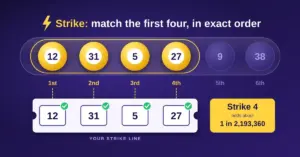
Powerball is an optional add-on, introduced in 2001, that creates the headline jackpots. Strike, an add-on running since 1993, asks players to pick four numbers from 1 to 40 and match them to the first four Lotto numbers drawn in the exact order and position. You can see recent Strike outcomes alongside the main results on the site’s Strike results page.
What changed with Powerball in September 2026?
Powerball was overhauled on 13 September 2026 under the Lotto Amendment Rules 2026. The key changes are:
- More Powerball numbers: players now pick 1 number from 1 to 14, up from 1 to 10.
- Bigger jackpot range: the starting jackpot rose from $4 million to $5 million, and the maximum cap rose from $50 million to $60 million.
- A new prize tier: Division 8 was added, so more tickets win a small fixed prize.
- Longer odds for the top prize: the chance of winning Powerball first division per line lengthened from about 1 in 38.4 million to about 1 in 53.7 million.
Ticket prices were unchanged. The first draw under the new format was held on 16 September 2026. If you played before this date, the extra Powerball numbers (11 to 14) did not exist, so older guides quoting “1 to 10” are out of date.
Keno
Keno is a fast numbers game played independently of Lotto. Players choose up to 10 numbers (“spots”) from a field of 1 to 80, and 20 numbers are drawn each time. Prizes depend on how many of your spots match and how much you staked. Keno has several draws every day rather than fixed weekly draws, which is why it feels quicker than Lotto. You can check the latest numbers on the Keno results page.
Bullseye
Bullseye is a daily game launched on 19 October 2009. Players choose a six-digit number from 000000 to 999999, or let the computer pick one (a “dip”). Matching the drawn Bullseye number wins the top division, with smaller prizes for partial matches. Because the number is six digits, the Bullseye game plays very differently from the ball-based games.
Instant Kiwi
Instant Kiwi is the brand for scratch and instant-win tickets, introduced in 1989 to replace the older Golden Kiwi lottery. Instead of waiting for a draw, players reveal the result immediately on a physical scratch card or through the online instant games. The range and prizes change regularly as new ticket designs are released; the current line-up is listed on the Instant Kiwi page.
How are draws run and prizes paid?
Draws are conducted under strict, audited procedures so that every ticket has the same chance set out in the rules. The outcome of each draw is random and cannot be predicted or influenced by the player, the retailer or the Commission.
Draw integrity and oversight
Each game runs under rules filed in New Zealand’s secondary legislation, and draws are carried out with certified equipment under independent supervision. The Department of Internal Affairs regulates the Commission, and the results and prize structures are published so that they can be checked. This oversight is what separates the official games from unofficial “lottery” websites that are not run by Lotto NZ.
Claiming prizes and the claim deadline
Small prizes can be collected from any Lotto retailer, while larger prizes are claimed directly through Lotto NZ. Wins on tickets bought through MyLotto are credited automatically to the player’s account. Crucially, prizes must be claimed within 12 months of the draw — a winning ticket left in a drawer can expire. Online play removes this risk because the system records and pays the win for you.
Where does the money go?
After prizes and the cost of running the games, all of Lotto NZ’s profit goes to the New Zealand Lottery Grants Board (Te Puna Tahua), which distributes it to community organisations across arts, sport, recreation, health and heritage. The Commission keeps none of the surplus for itself.
The sums are significant. In the year to 30 June 2024, Lotto NZ returned a record $434 million to the community, and more than $5 billion has been returned since the first draw in 1987. Thousands of organisations receive funding each year, which is why Lotto NZ frames its games as entertainment that also supports local causes — though, as with any lottery, the money raised comes from player spending.
How is Lotto NZ regulated?
Lotto NZ operates under a clear legal framework, not the frequently cited but non-existent “New Zealand Lotteries Commission Act 1997”. The New Zealand Lotteries Commission was originally established under section 72 of the Gaming and Lotteries Act 1977 and is now continued in existence under the Gambling Act 2003, which is the main statute governing gambling in New Zealand. Individual games are governed by their own rules (for example the Lotto Rules, Keno Rules and Bullseye Rules) made under that Act and approved by the Minister of Internal Affairs.
The Department of Internal Affairs is the regulator, and as a Crown entity Lotto NZ is also subject to the Crown Entities Act 2004. Together these set its reporting, integrity and responsible-gambling obligations.
Common mistakes and misconceptions about Lotto NZ
A few misunderstandings come up repeatedly. Knowing them helps you deal with the real organisation rather than a look-alike.
- Assuming any “NZ lottery” website is official. Only Lotto NZ runs Lotto, Powerball, Strike, Keno, Bullseye and Instant Kiwi. These games are sold through authorised retailers and MyLotto; overseas sites that resell or imitate them are not the Commission.
- Confusing Lotto NZ with other operators. The TAB (racing and sports betting) and casinos such as SkyCity are separate organisations with different regulators. Lotto NZ runs lottery products only.
- Believing a system or “strategy” improves your odds. Draws are random, and the published odds apply to every line regardless of which numbers you pick or how often you play. No pattern, hot-number list or paid tip changes them.
- Using out-of-date Powerball facts. Since 13 September 2026 the Powerball field is 1 to 14, not 1 to 10, and the top-prize odds are longer. Older articles quoting the previous numbers are wrong.
- Letting a winning ticket expire. Prizes must be claimed within 12 months of the draw, so a paper ticket needs to be checked promptly.
- Treating lottery spending as an investment. Lotto games are entertainment with a negative expected return; the community funding they generate comes from players’ net losses, not from “free” money.
Responsible gambling and disclaimer
This article is general information about the New Zealand Lotteries Commission and its games, not gambling, financial or legal advice. Lottery games are games of chance: outcomes are random, the odds favour the operator, and no information in this guide can improve your chance of winning. You must be 18 or over to buy Lotto NZ products.
If gambling is causing you or someone you know harm, free, confidential help is available in New Zealand. Contact the Gambling Helpline on 0800 654 655, and set limits before you play. The site’s responsible gambling page has further guidance and support options.
Sources
- Gambling Act 2003 (continuation of the New Zealand Lotteries Commission) — legislation.govt.nz
- Lotto Amendment Rules 2026 — legislation.govt.nz
- ‘Gamechanger’: Major changes coming to Lotto Powerball — 1News
- Lotto NZ Players Help Return Record $434 Million To Community — Scoop
- Lottery Grants Board (Te Puna Tahua) — communitymatters.govt.nz
- Gambling — history of Lotto and the Lotteries Commission, Te Ara Encyclopedia of New Zealand
- Bullseye Rules 2009 — legislation.govt.nz
Frequently Asked Questions (FAQ)
Is the New Zealand Lotteries Commission the same as Lotto NZ?
Yes. “New Zealand Lotteries Commission” is the organisation’s legal name and “Lotto New Zealand” (Lotto NZ) is the public brand it has used since 2013. They are the same state-owned entity, which is why official rules still use the longer name while tickets and advertising say Lotto NZ.
What games does the New Zealand Lotteries Commission run?
It runs Lotto and its add-ons Powerball and Strike, plus Keno, Bullseye and the Instant Kiwi range of scratch and instant-win tickets. These are the only official nationwide lottery games in New Zealand; any other site offering “NZ Lotto” is not the Commission.
How old do you have to be to play Lotto NZ games?
You must be 18 or over to buy any Lotto NZ product, whether in store or online. Retailers and the MyLotto platform can ask for proof of age, and selling lottery products to minors is not permitted.
Where does the money from Lotto NZ go?
After prizes and running costs, all of Lotto NZ’s profit goes to the New Zealand Lottery Grants Board, which funds community organisations in areas such as arts, sport, health and heritage. A record $434 million was returned in the year to 30 June 2024, and more than $5 billion has been returned since 1987.
What changed with Powerball in September 2026?
From 13 September 2026 players pick a Powerball number from 1 to 14 instead of 1 to 10. The starting jackpot rose to $5 million, the cap rose to $60 million, a new Division 8 was added, and the odds of winning the top prize lengthened to about 1 in 53.7 million per line. Ticket prices stayed the same.