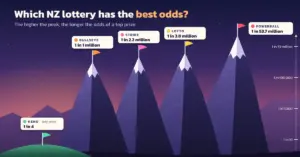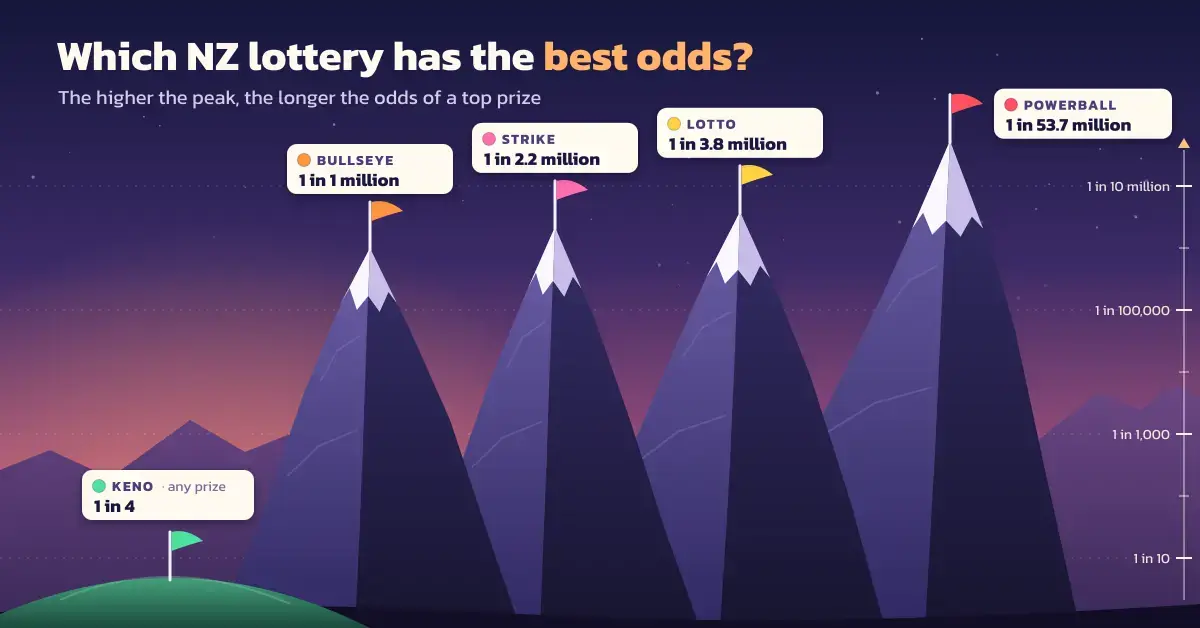
If you want the single best chance of winning anything, Keno is the clear answer: a one-number Keno play wins roughly one time in four. If you mean the best chance of winning a jackpot, the answer changes to Bullseye, then Strike and Lotto, with Powerball the hardest of all at about 1 in 53.7 million. “Best odds” means two different things in a lottery, and the game that wins one question loses the other. This guide compares all five New Zealand games Lotto NZ runs — Lotto, Powerball, Strike, Keno and Bullseye — on the exact odds of winning, so you can see where each one really sits.
Key Points
- Best odds of winning anything: Keno — a one-spot play wins about 1 in 4.
- Best odds of a jackpot: Bullseye, 1 in 1,000,000 — but for a fixed six-figure prize, not millions.
- Best odds among the big-money games: Lotto First Division, 1 in 3,838,380 — far shorter than Powerball.
- Longest odds of all: Powerball, 1 in 53,737,320 since the 13 September 2026 change — but the biggest prize.
- No game can be beaten with a system: every number has the same chance in every draw.
Which NZ lottery has the best odds of winning any prize?
Keno has the best odds of winning any prize of all five games — a one-spot play wins about 1 in 4. Bullseye’s easiest consolation tier is next, at about 1 in 11, and a single standard Lotto line wins its lowest division roughly 1 in 35. The catch is that the easiest wins are also the smallest.
Keno: about 1 in 4 on a one-spot play
Keno lets you play between one and ten numbers (called “spots”) from a pool of 1 to 80, and each draw 20 of those 80 numbers are picked. If you play a single spot, your one number simply has to be among the 20 drawn — that is 20 out of 80, or 1 in 4. No other New Zealand lottery comes close for frequency of winning. Keno is drawn four times a day (10am, 1pm, 3pm and 6pm), lines start from $1, and you can add a Multiplier of up to 10x to boost non-jackpot prizes. The trade-off is obvious: a one-spot win returns only a small fixed amount, so you win often but win little.
Bullseye: about 1 in 11 on the widest consolation tier
Bullseye is a $2 game drawn daily at 6pm. Every play is a six-digit number from 000000 to 999999. You win the jackpot by matching that number exactly, but there are also consolation tiers for landing “within” a set distance of the winning number — the widest, within 5,001 to 50,000 either side, comes up about 1 in 11. Those near-miss prizes are fixed and modest, with the smallest tier paying a $2 bonus ticket, effectively a free entry into the next draw.
Lotto: about 1 in 35 for the lowest division
In standard Lotto you pick six numbers from 1 to 40, and a bonus ball is drawn as well. The lowest prize, Division 7, needs just three of your six numbers to match and comes up about 1 in 35 per line. Because a $0.70 Lotto line costs a fraction of a full ticket, Lotto NZ usually quotes the odds per ticket — a $7 ticket is ten $0.70 lines, and at 1 in 383,838 for First Division that works out to 1 in 3,838,380 for a single line. A coupon carries at least four lines, so a real Lotto ticket wins small prizes fairly regularly — just rarely the big ones. If you want the full breakdown, our guide to the odds of winning Lotto works through every division.
Which NZ game has the best odds of winning the jackpot?
For the top prize, Bullseye has the shortest odds at 1 in 1,000,000, followed by Strike Four at 1 in 2,193,360 and Lotto’s First Division at 1 in 3,838,380. Powerball is the longest of all at 1 in 53,737,320. The table below lines them up on the same measure — what you must match and the odds of doing it.
Odds by game
| Game (top prize) | What you must match | Odds of the top prize |
|---|---|---|
| Bullseye jackpot | Your six-digit number, exactly | 1 in 1,000,000 |
| Strike (Strike Four) | The first four Lotto numbers, in exact order | 1 in 2,193,360 |
| Lotto (First Division) | All six of your numbers from 40 | 1 in 3,838,380 |
| Powerball (First Division) | Six numbers from 40, plus the Powerball (1 of 14) | 1 in 53,737,320 |
Bullseye jackpot: 1 in 1,000,000
Because a Bullseye entry is a single six-digit number and there are exactly one million possible six-digit numbers, matching it is a flat 1 in 1,000,000 — the shortest jackpot odds of any New Zealand lottery, shorter even than Lotto’s First Division. The reason it is not the obvious “best” choice is prize size: the Bullseye jackpot is a fixed sum starting at a guaranteed $100,000 (capped at $400,000), not the millions a Lotto or Powerball draw can reach. You can read more about how Bullseye works and what each tier pays.
Strike Four: 1 in 2,193,360
Strike is a $1 add-on played on the main Lotto draw. You pick four numbers and must match the first four balls drawn in Lotto — in the exact order they come out. Getting four specific numbers in the right order from 40 is 40 × 39 × 38 × 37, or 1 in 2,193,360 — shorter odds than winning Lotto First Division, which surprises many players. The lower Strike tiers are far easier: Strike One is 1 in 11, Strike Two is 1 in 274 and Strike Three is 1 in 15,232. Our page on how Lotto Strike works explains the order rule in detail.
Lotto First Division: 1 in 3,838,380
Matching all six of your numbers from 40 is 1 in 3,838,380 — the number of possible six-number combinations. This is the classic “win the jackpot” figure, and it is the best odds among the big multi-million-dollar games. It is fixed: the odds do not change whether the jackpot is $4 million or $50 million. See how Lotto NZ works for the full set of game rules.
Powerball: 1 in 53,737,320
Powerball is an optional $0.80 add-on to a Lotto line. On top of your six main numbers you also play one Powerball number, and winning Powerball First Division means matching all six main numbers and the Powerball. Since the 13 September 2026 overhaul, the Powerball pool grew from 10 numbers to 14, which lengthened the First Division odds from about 1 in 38.4 million to 1 in 53,737,320. The same change lifted the maximum jackpot to $60 million and added a new Division 8 fixed $12 prize. Powerball therefore has the longest odds and the biggest prize of any New Zealand game. Our explainer on the 2026 Powerball changes covers what moved and why.
Why better odds don’t always mean better value
Odds tell you how likely a win is, not how much it is worth, and the two rarely point the same way. A one-spot Keno win is common but tiny; a Powerball jackpot is enormous but astronomically unlikely. As a rule, shorter odds come with smaller prizes, and the headline jackpots come with the longest odds — that is not a coincidence, it is how every lottery balances its prize pool. To judge value you would weigh the odds against the prize, and on that measure no lottery is a good financial bet: Lotto NZ pays out only about 53 cents in prizes for every $1.00 spent across its games, with the rest going to running costs and community funding. In other words, the house keeps nearly half, whichever game you choose.
That is worth remembering when a jackpot is in the headlines. A bigger prize pool does not shorten the odds — a $60 million Powerball is exactly as hard to win as a $5 million one. The prize grows; your chance does not.
Common mistakes people make about lottery odds
Most myths about “improving your odds” come from misreading how the draws work. The big ones:
- Thinking “lucky” or most-common numbers are more likely to come up. Every number has the same chance in every draw. Past frequency does not change the odds of the next draw, so picking the historically most-drawn numbers does nothing for your chances — it only changes who you might share a prize with.
- Believing a system or pattern beats the game. There is no selection method, hot-and-cold chart or pattern that shortens the published odds. We cover what does and does not help in our look at whether any keno strategy works.
- Confusing the easiest win with the best game. Keno’s 1 in 4 is tempting, but it is the odds of a small fixed prize, not a jackpot. Compare like with like.
- Assuming Powerball is “just” Lotto with a bonus. Adding the Powerball number makes the top prize far harder, not easier — it multiplies the combinations by 14.
- Thinking a Must Be Won draw improves the odds. It changes how the prize is shared if no one wins the top division outright, but your own line’s odds stay exactly the same.
Responsible gambling
All of these games are games of chance, and the figures above show how long the real odds are. Nothing in this guide is a tip for winning — no game, number choice or system changes the published odds. If gambling is causing you or someone you know harm, free and confidential help is available 24 hours a day from Gambling Helpline Aotearoa on 0800 654 655. Set a budget before you play and treat any spend as entertainment, not an investment.
Sources
- Wikipedia — Lotto New Zealand (game rules, prices and odds)
- Safer Gambling Aotearoa — How Lotto works
- Lottery Guru — New Zealand Keno rules and odds
- Lottery Guru — New Zealand Bullseye rules and odds
- 1News — Lotto’s top prize to hit $60m, but it’s never been harder to win (28 Aug 2026)
- Gambling Helpline Aotearoa
Frequently Asked Questions (FAQ)
Which NZ lottery is easiest to win a prize on?
Keno. A one-spot Keno play wins about 1 in 4, because your single number only has to be among the 20 numbers drawn from 80. It is the shortest odds of winning anything of any New Zealand lottery, though the prize for a one-spot win is small and fixed.
Is Powerball or Lotto easier to win?
Lotto is far easier. Lotto First Division is 1 in 3,838,380, while Powerball First Division is 1 in 53,737,320 since the September 2026 change, because Powerball requires your six main numbers plus the separate Powerball number. Powerball offers the bigger prize precisely because it is harder to win.
What are the most common Lotto numbers in New Zealand?
Over the past five years, 17 and 24 have been the most frequently drawn Lotto numbers, while Powerball number 1 has appeared most often. Tempting as that looks, it does not make them more likely to come up next time: every draw is independent, so past frequency does not change the odds. Choosing the most-drawn numbers only affects how many other people might pick the same line and share a prize with you.
What home or charity lottery has the best odds in NZ?
Charity “home” or house lotteries — such as hospital or heart foundation lotteries — are a different product from Lotto NZ’s games. They sell a fixed number of tickets for a set draw, so the odds depend entirely on how many tickets exist and how many you hold, and they are stated on each lottery’s own entry page rather than being fixed like Lotto’s. They are not directly comparable to the per-line odds of Lotto, Keno, Powerball, Strike or Bullseye.
Can buying more tickets improve my odds?
Yes, but only in proportion to what you spend. Two lines are twice as likely to win as one, but two in several million is still almost nothing, and your cost doubles. Buying more entries is the only thing that genuinely changes your chance — no number-picking method does.