If you have ever found an old ticket in a drawer and wondered whether it is still worth anything, the rule in New Zealand is clear: a standard draw-based lottery ticket is valid for exactly 12 months from the date of the draw. That single window applies across Lotto, Powerball, Strike, Keno and Bullseye, whether you bought a paper slip at a dairy or entered online. After the 12 months are up, the ticket can no longer be paid out, and any prize sitting on it is forfeited. This guide explains when the clock starts, what the law says, what happens to unclaimed money, how online entries differ, and the practical steps that stop a winning ticket slipping past its deadline.
Key Points
- 12 months to claim. Draw-based tickets (Lotto, Powerball, Strike, Keno, Bullseye) are valid for 12 months from the draw date.
- Instant Kiwi is different. The 12 months run from the game’s official closing date, not from purchase.
- No exceptions. After the deadline the ticket cannot be paid out, from a small win to a jackpot.
- Unclaimed money recycles. Expired prizes return to the prize reserve to fund future jackpots and promotions.
- Online is safer. MyLotto entries are tied to your account and small prizes are auto-credited, so they rarely expire.
- Prizes are tax-free. Validated wins are paid in full at any point inside the 12-month window.
How long are Lotto tickets valid for in NZ?
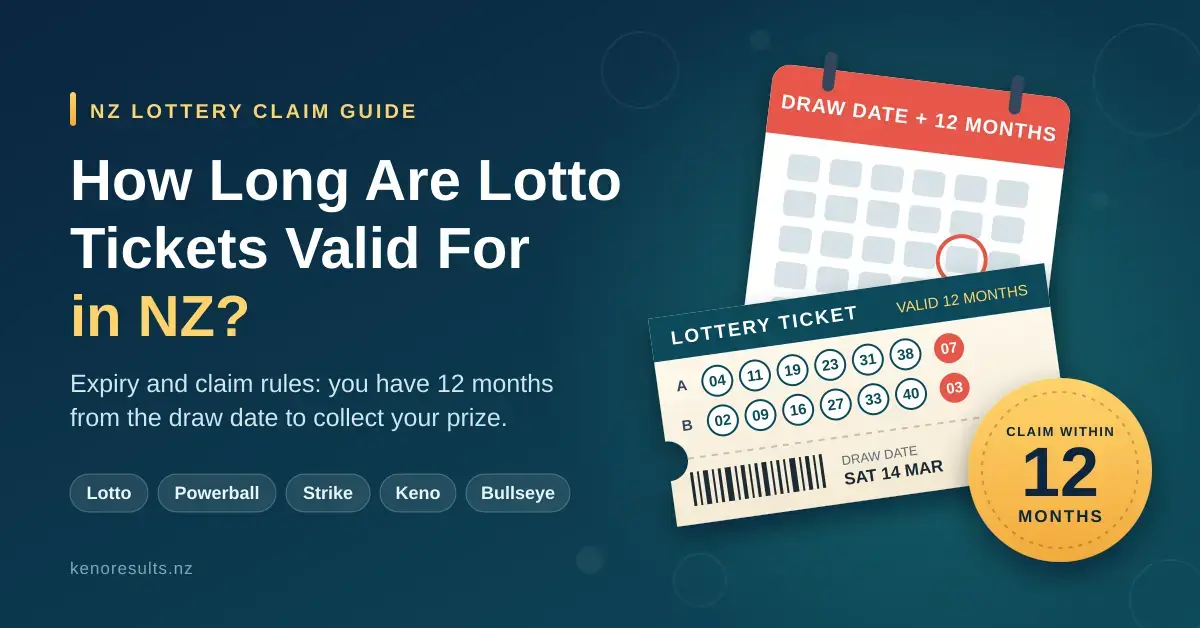
Draw-based Lotto tickets in New Zealand are valid for 12 months from the draw date. If you hold a ticket for a Saturday draw, you have until the same date the following year to check it and claim any prize; once that date passes, the ticket is treated as expired. The rule is the same for every draw-based product sold by Lotto NZ, so there is no separate, longer window for big jackpots or a shorter one for small wins.
When does the 12-month countdown start?
For draw games, the countdown starts on the date of the specific draw your numbers were entered into, not the date you bought the ticket. A single physical ticket can cover several future draws (for example a multi-draw or subscription entry), and in that case each draw has its own 12-month deadline counted from that draw’s date.
Instant Kiwi scratch tickets work differently. Their 12-month claim window runs from the official closing date of that particular game, which is the date Lotto NZ withdraws the game from sale, rather than from when you bought or scratched the ticket. If you want the finer detail on scratch games, see the dedicated guide to Instant Kiwi in New Zealand.
Which games the 12-month rule covers
The table below shows when the clock starts for each format. The claim window itself is 12 months in every case.
| Game | When the 12 months start | Claim window |
|---|---|---|
| Lotto (and bonus ball) | The draw date | 12 months |
| Powerball | The draw date | 12 months |
| Strike | The draw date | 12 months |
| Keno | The specific draw date | 12 months |
| Bullseye | The specific draw date | 12 months |
| Instant Kiwi | The game’s official closing date | 12 months |
What law sets the ticket expiry rule?
The expiry rule sits under New Zealand’s Gambling Act 2003, which governs how Lotto NZ (the trading name of the New Zealand Lotteries Commission) runs its games and handles prizes. Under the Act, a prize that is not claimed within 12 months of the draw is dealt with according to the game rules, which is what gives Lotto NZ the legal basis to close the claim window at the 12-month mark. Because the deadline is set in the rules rather than left to discretion, staff and retailers cannot extend it or make an exception, no matter how large the prize.
What happens when a Lotto ticket expires?
Once a ticket passes its 12-month deadline, it stops being payable and the terminal network will no longer validate it. If a retailer scans an expired ticket, the system flags it as past its claim date and the store is not able to pay out. There is no late conversion, no partial credit, and no process to swap an old ticket for a new entry, so an expired winning ticket simply loses its value.
A small share of New Zealand prizes go unclaimed every year, from minor cash wins that holders never bother to collect through to the occasional large prize where the ticket is lost or forgotten. Lotto NZ typically tries to trace big unclaimed winners through regional media before the deadline, but if no one comes forward in time the prize still expires. If you think you are holding a winner, the safest move is to validate and claim your Lotto winnings well before the date rather than leaving it to the last week.
Where does unclaimed prize money go?
Unclaimed prize money is not kept as profit by Lotto NZ. Under the game rules made within the Gambling Act 2003, money from expired prizes is returned to the prize reserve, where it is held to top up future jackpots and fund promotional and guaranteed draws. In other words, a prize that one player forgets eventually flows back to the wider pool of players through later draws rather than to the operator’s bottom line.
This is separate from the profits Lotto NZ distributes to the community. Those profits are returned through the New Zealand Lottery Grants Board to support sport, arts, heritage and community groups, and come from sales rather than from expired prizes.
Quick Facts
| Claim window | 12 months |
|---|---|
| Countdown starts (draw games) | The draw date |
| Countdown starts (Instant Kiwi) | The game’s official closing date |
| Operator | Lotto NZ (New Zealand Lotteries Commission) |
| Governing law | Gambling Act 2003 |
| Unclaimed prizes | Returned to the prize reserve for future draws |
| Tax on prizes | None (treated as windfall gains) |
| Where to check | MyLotto app/website or an in-store self-scanner |
Do online MyLotto tickets expire the same way?
Online entries are subject to the same 12-month rule in principle, but in practice the risk of missing the deadline is far lower. When you buy through the MyLotto website or app, your entries are tied to your verified account instead of a loose piece of paper, so there is nothing to lose or damage. Smaller prizes are credited automatically to your online wallet after the draw, which effectively removes the expiry risk for those wins, while larger prizes still prompt a formal claim process linked to your identity.
Even with a paper ticket, you do not have to rely on memory. The official MyLotto app lets you scan a ticket’s barcode with your phone to check it, and you can also use an in-store self-scanner. For a walk-through of checking results, see how a Lotto ticket scanner works.
How to protect a paper ticket before it expires
Thermal paper tickets fade and can be misplaced, and a damaged barcode can slow down or complicate a claim. A few simple habits keep a physical ticket readable and clearly yours for the full 12-month window.
- Sign the back straight away. Writing your name and signature on the reverse helps establish ownership if the ticket is lost or stolen.
- Keep it out of heat and sunlight. Thermal paper darkens and becomes unreadable if left on a car dashboard or in direct sun, and laminating can ruin it, so store it flat and cool.
- Give it a fixed home. A dedicated folder, drawer or clip means tickets do not end up in the bin or down the back of the couch.
- Check early, not late. Scan or validate soon after the draw. If a barcode is too faded to scan but the ticket is still within its window, a retailer can key in the serial numbers printed on it to look up the result.
Do Keno, Bullseye and Strike follow the same rule?
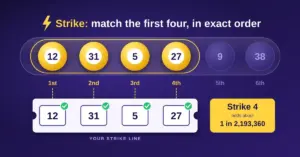
Yes. The daily and add-on games use the same 12-month claim window as the main Lotto and Powerball draws; only the mechanics differ. Keno draws from a field of 80 numbers, with 20 drawn each game and multiple draws a day, and players choose how many numbers to play. Bullseye is a daily six-digit game where you aim to match the number drawn. Strike is an add-on to the Lotto draw in which you try to pick the first four numbers in the exact order they come out.
Because the claim window does not change between games, the same advice applies to every ticket: check it promptly and claim well inside the year. If you enjoy the daily formats, the site has a full explainer on how Bullseye works in NZ.
Common mistakes people make with ticket expiry
Most missed prizes come down to a handful of avoidable errors rather than the 12-month rule itself being unclear.
- Counting from the purchase date. For draw games the clock starts on the draw date, not when you bought the ticket, which can shift the deadline on multi-draw entries.
- Assuming small wins do not matter. Minor prizes expire too, and they make up a large part of the money left unclaimed each year.
- Confusing Instant Kiwi with draw games. Scratch tickets expire 12 months after the game closes, so a ticket bought early in a game’s life has less time left than its purchase date suggests.
- Letting a ticket fade. Leaving a slip in the sun or a hot car can make the barcode unscannable; keep it cool and consider going digital.
- Leaving it to the final week. There is no grace period at 12 months, so last-minute claims leave no room if a ticket is damaged or a store cannot process it.
Keeping lottery play in perspective
Knowing the rules is useful, but it is worth remembering that every draw is random and the top-tier odds are very long. Since the Powerball changes on 13 September 2026, the chance of a Powerball Division 1 win is about 1 in 53.7 million per line, with the jackpot now starting at $5 million and capped at $60 million. For a fuller breakdown, see the guide to the odds of winning Powerball in NZ.
One piece of good news for winners is that New Zealand lottery prizes are treated as windfall gains and are not taxed, so a validated prize is paid in full regardless of when you claim it inside the 12-month window. You can read more about why lottery winnings are tax-free in NZ.
Responsible Gambling
Lotto games are based on chance, and no system, number pattern or staking method changes the odds of a draw. Only ever spend what you can comfortably afford as entertainment, and never use money set aside for rent, bills, food or savings to buy tickets. Warning signs include spending more to chase a rising jackpot, arguments about gambling, or feeling anxious about how much you play. Support in New Zealand is free and confidential: the Gambling Helpline is available on 0800 654 655 or by texting 8006, and more information is available through Safer Gambling Aotearoa. You must be 18 or over to buy lottery products in New Zealand. This article is general information about ticket validity and is not financial or legal advice.
Sources
- Gambling Act 2003 (New Zealand Legislation)
- 1News — Time running out for Lotto first division winner to claim prize
- 1News — Why tonight’s Lotto jackpot will be harder to win (Powerball changes)
- 1News — Lotto’s top prize to hit $60m
- Keno Rules 2025 (New Zealand Legislation)
- Gambling Helpline Aotearoa
- Safer Gambling Aotearoa
Frequently Asked Questions (FAQ)
How long are Lotto tickets valid for in NZ?
Standard draw-based tickets, including Lotto, Powerball, Strike, Keno and Bullseye, are valid for 12 months from the date of the relevant draw. After that date the ticket expires and can no longer be paid out.
Do online tickets expire the same way as paper ones?
The 12-month rule applies to online entries too, but the risk is much lower because MyLotto ties entries to your account and credits smaller prizes to your wallet automatically. Larger prizes still trigger a formal claim linked to your identity.
What happens to the money if a ticket is never claimed?
Unclaimed prize money is returned to the prize reserve rather than kept as profit, where it is used to boost future jackpots and fund promotional or guaranteed draws for other players.
Can a retailer pay out a ticket that expired a few days ago?
No. Once a ticket passes its 12-month deadline the terminal network flags it as expired and no retailer can pay out on it. There is no grace period or appeal, as the deadline is set in the game rules.
When does the clock start for an Instant Kiwi scratch ticket?
Instant Kiwi prizes must be claimed within 12 months of the official closing date of that game, which is when Lotto NZ withdraws it from sale, rather than from the date you bought or scratched the ticket.