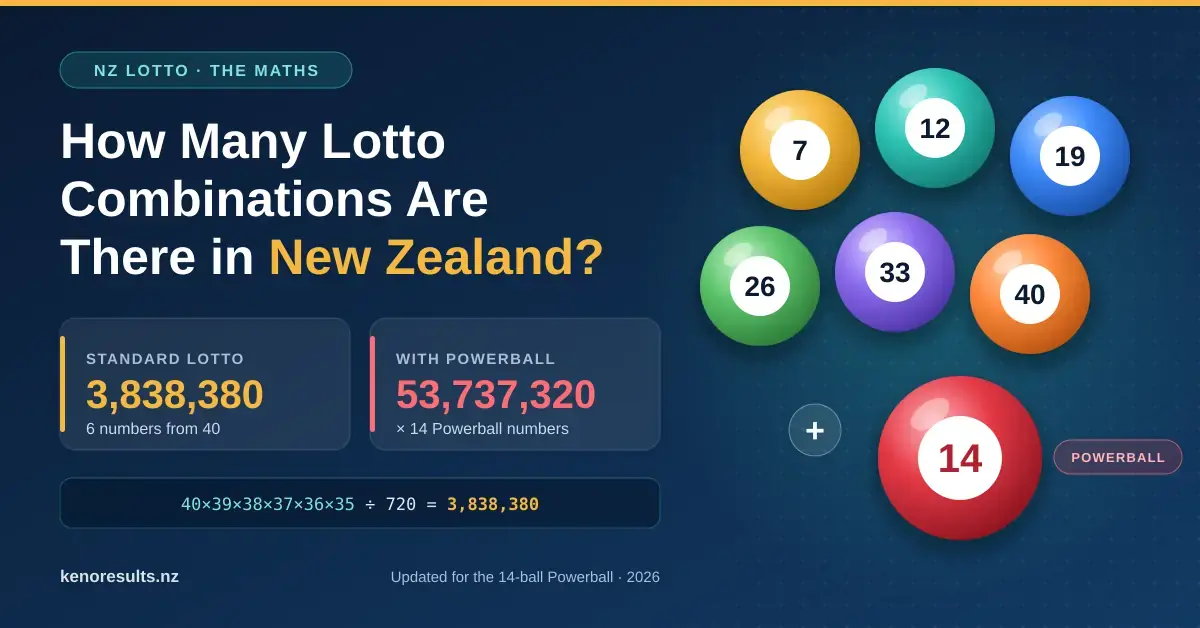
New Zealand’s main Lotto game is built on a fixed set of number combinations, and the total is easy to state: choosing six numbers from a pool of 40 produces exactly 3,838,380 unique standard combinations. Adding Powerball, which since 13 September 2026 draws from an enlarged pool of 14 numbers, multiplies that figure to 53,737,320 possible lines. This guide explains where those numbers come from, how the maths changed in 2026, and what it means for the games run by the New Zealand Lotteries Commission (Lotto NZ) — standard Lotto, Powerball, Lotto Strike, Keno and Bullseye. Every figure here is drawn from current Lotto NZ rules and recent reporting, with the combinatorics shown step by step so you can check the work yourself.
Key Facts
- Standard Lotto combinations: 3,838,380 (6 numbers from 40)
- Lotto + Powerball combinations: 53,737,320 (since the 14-ball change on 13 September 2026)
- Lotto Strike combinations: 2,193,360 (first 4 balls in exact order)
- Powerball Division 1 odds: 1 in 53,737,320 per line
- Line prices: $0.70 standard Lotto, $1.50 with Powerball ($0.80 add-on), minimum 4 lines
- Powerball jackpot: starts at $5 million, caps at $60 million
- Age limit: 18+ to buy, in-store and online (2026 law change)
- Tax: prizes are tax-free windfall gains
How many combinations are in standard NZ Lotto?
Standard Lotto has exactly 3,838,380 unique combinations. The main draw uses a single machine holding 40 balls numbered 1 to 40, from which six main winning numbers are drawn plus a separate seventh ball called the Bonus Ball. Your line matches a prize division based on how many of your six chosen numbers come up.
Because the order the balls appear in does not matter for a standard line, the count is a “combination” rather than a “permutation”. Statisticians write it as C(n, r), where n is the pool size (40) and r is how many you pick (6). Working the formula — 40! ÷ (6! × 34!) — gives 3,838,380. That single number sets the odds for the top standard division: 1 in 3,838,380 per line.
Standard Lotto odds by division
The 3,838,380 baseline fixes the odds for all seven standard divisions, which ease as fewer matches are required. These odds are unchanged by the 2026 Powerball update, because that change affected only the separate Powerball machine.
| Division | What you must match | Odds per line |
|---|---|---|
| Division 1 | 6 main numbers | 1 in 3,838,380 |
| Division 2 | 5 main numbers + Bonus Ball | 1 in 639,730 |
| Division 3 | 5 main numbers | 1 in 19,386 |
| Division 4 | 4 main numbers + Bonus Ball | 1 in 7,754 |
| Division 5 | 4 main numbers | 1 in 485 |
| Division 6 | 3 main numbers + Bonus Ball | 1 in 363 |
| Division 7 | 3 main numbers | 1 in 35 |
Only Division 1 pays from a jackpot pool; the lower standard divisions pay smaller, pari-mutuel or fixed amounts, and Division 7 returns four bonus Lotto lines. For a fuller breakdown of what each tier pays, see our guide to Lotto prize divisions.
How does Powerball change the number of combinations?
Adding Powerball multiplies the standard 3,838,380 combinations by the number of balls in the Powerball pool, which is now 14. That gives 53,737,320 possible Lotto-plus-Powerball lines, and the odds of the Powerball jackpot are therefore 1 in 53,737,320 per line. Powerball is drawn from its own independent machine, so you choose one Powerball number (1 to 14) for each standard line you play.
This is a recent change. Until 12 September 2026 the Powerball pool ran from 1 to 10, so the matrix was 3,838,380 × 10 = 38,383,800 lines, with jackpot odds of 1 in 38,383,800. From the draw of 13 September 2026, Lotto NZ expanded the pool to 14 numbers. The multiplication is the only step that changed: 3,838,380 × 14 = 53,737,320. The upshot is a top prize that is harder to win on any single line but that rolls over more often, producing bigger headline jackpots. You can read more about the current numbers on our page covering the Powerball odds in New Zealand.
Powerball divisions and odds after the September 2026 change
The expansion also added an eighth Powerball division and lengthened the odds across the top tiers. The table below reflects the structure in force since 13 September 2026.
| Division | What you must match | Odds per line |
|---|---|---|
| Division 1 | 6 main numbers + Powerball | 1 in 53,737,320 |
| Division 2 | 5 main + Bonus Ball + Powerball | 1 in 8,956,220 |
| Division 3 | 5 main + Powerball | 1 in 271,401 |
| Division 4 | 4 main + Bonus Ball + Powerball | 1 in 108,560 |
| Division 5 | 4 main + Powerball | 1 in 6,785 |
| Division 6 | 3 main + Bonus Ball + Powerball | 1 in 5,089 |
| Division 7 | 3 main + Powerball | 1 in 493 |
| Division 8 (new) | 2 main + Bonus Ball + Powerball | 1 in 657 |
Division 8 pays a fixed $12, and Lotto NZ expects it to lift the average number of weekly Powerball winners by roughly 30 per cent even as top-tier wins become rarer. Each Powerball division sits on top of the matching standard Lotto division, so a single line can win in both a Lotto division and a Powerball division at once.
What the bigger matrix means for the jackpot
The larger matrix is why Powerball now starts higher and climbs higher. As part of the September 2026 change, the Powerball Division 1 starting jackpot rose from $4 million to $5 million, and the maximum it can reach before a “Must Be Won” draw was lifted from $50 million to $60 million.
The scale of 53,737,320 lines also explains why “buying every combination” is never a plan. At $1.50 for a single Lotto-plus-Powerball line, covering the entire matrix would cost $80,605,980 — comfortably more than the $60 million cap, so even a guaranteed Division 1 win would be a large net loss before you account for the many duplicate lower-division prizes you would also hold.
How many combinations does Lotto Strike have?
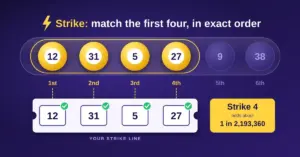
Lotto Strike has 2,193,360 possible combinations, and it uses different maths from standard Lotto because order matters. Strike asks you to predict the first four balls drawn from the main 40-ball machine in the exact sequence they appear. When position counts, the calculation is a permutation, not a combination.
The maths tracks the shrinking pool as each ball is removed: 40 options for the first position, 39 for the second, 38 for the third and 37 for the fourth. Multiplying 40 × 39 × 38 × 37 gives 2,193,360 unique ordered sequences, which is why the top Strike 4 prize sits at 1 in 2,193,360 per line. Current and past numbers are published on the Lotto Strike results page.
Strike divisions
- Strike 4 — 1 in 2,193,360: match all four numbers in their exact drawn order to win the Strike jackpot, which starts at $200,000 and can roll to $1,500,000.
- Strike 3 — 1 in 15,232: match any three of the first four balls in their correct positions for a prize that averages around $668.
- Strike 2 — 1 in 274: match any two of the first four balls in position for a fixed prize of about $67.
- Strike 1 — 1 in 11: match one ball in its correct position and win one bonus Strike line.
Do bigger tickets and Lucky Dips cover more of the matrix?
More lines do give you more entries, but the effect on your real coverage is tiny because the matrix is so large. A common Power Dip of 10 lines, for example, covers just 0.0000186 per cent of the 53,737,320 possible Powerball lines. Buying three times as many lines simply triples a very small number.
The table below shows how coverage scales for a Lotto-plus-Powerball ticket at $1.50 per line. A standard coupon requires a minimum of four lines; a Lucky Dip or Power Dip is the same thing with the numbers chosen at random by Lotto NZ’s computer rather than by you — the odds are identical either way. If you prefer to compare the full range of entry costs, see our page on Combo entry costs.
| Lines played | Cost at $1.50/line | Approx. share of the 53,737,320-line matrix |
|---|---|---|
| 1 line | $1.50 | ~0.0000019% |
| 4 lines (minimum) | $6.00 | ~0.0000074% |
| 10 lines | $15.00 | ~0.0000186% |
| 30 lines | $45.00 | ~0.0000558% |
| 100 lines | $150.00 | ~0.000186% |
Whether a line is a hand-picked selection or an automated Lucky Dip random selection, every one of the 53,737,320 lines carries exactly the same chance of being drawn.
How do System and Combo entries build combinations?
A System or Combo entry lets you choose more than six numbers on one coupon, and the terminal then generates every valid six-number combination from your chosen group. The number of lines follows the same C(n, 6) formula used for the whole game, so it grows quickly as you add numbers.
- Pick 7 numbers: C(7,6) = 7 lines — $4.90 for standard Lotto, or $10.50 with Powerball.
- Pick 8 numbers: C(8,6) = 28 lines — $19.60 standard, or $42.00 with Powerball.
- Pick 9 numbers: C(9,6) = 84 lines — $58.80 standard, or $126.00 with Powerball.
- Pick 10 numbers: C(10,6) = 210 lines — $147.00 standard, or $315.00 with Powerball.
A System entry does not change the odds of any individual line; it simply buys many related lines at once, so the cost scales linearly at $0.70 per standard line or $1.50 per Powerball line.
How do Keno and Bullseye combinations compare?
Keno and Bullseye run on completely separate number fields from Lotto, so their combination counts are not comparable to the 3,838,380 Lotto figure. Keno draws 20 balls from an 80-number board several times a day; on a 10-spot ticket, matching all ten of your numbers has odds of about 1 in 8,911,711. Bullseye instead asks you to match a six-digit number, giving 1,000,000 possible values (000000 to 999999) and top-tier odds of 1 in 1,000,000.
The box below sets the main Lotto NZ games side by side so you can see how the underlying maths differs. You can explore the daily draws further on our Bullseye page.
Game Combinations Compared
| Game | Selection | Number field | Total unique lines | Top-tier odds per line |
|---|---|---|---|---|
| Lotto (standard) | 6 numbers | 1–40 | 3,838,380 | 1 in 3,838,380 |
| Lotto + Powerball | 6 numbers + 1 Powerball | 1–40 and 1–14 | 53,737,320 | 1 in 53,737,320 |
| Lotto Strike | 4 numbers in exact order | 1–40 | 2,193,360 | 1 in 2,193,360 |
| Keno (10-spot) | 10 numbers (20 drawn) | 1–80 | — | ~1 in 8,911,711 |
| Bullseye (Jackpot) | 6-digit number | 000000–999999 | 1,000,000 | 1 in 1,000,000 |
Does the past influence which combinations come up?
No — past draws have no effect on future ones, and no combination is ever “overdue”. This belief is known as the gambler’s fallacy: the mistaken idea that a number or line that has not appeared for a long time is somehow more likely to come up. The machines have no memory of earlier results.
Each draw is an independent event. Whatever happened last Wednesday or three years ago, the chance of any specific Powerball line is fixed at 1 in 53,737,320 on every draw. Randomness naturally produces short streaks and clusters that look like patterns to us, but they carry no predictive value, and the odds of winning Lotto stay the same no matter how large the jackpot has grown.
How are the draws kept fair and random?
Lotto NZ draws are overseen by an independent Audit NZ scrutineer, and no draw can proceed without one present. Before each live draw, the machine and ball set used for Lotto, and separately for Powerball, are selected by a coin toss on the night, tossed by the Audit NZ scrutineer and witnessed by a Lotto NZ representative. Lotto NZ keeps several machines and ball sets in rotation so no single set is used predictably.
The equipment is checked regularly. Lotto NZ has said the balls are washed and weighed roughly every ten draws, and if a single ball is found to be outside specification the entire set is destroyed. Draws are broadcast live on television (usually TVNZ 1), and when a live draw cannot go ahead — for example during a studio power outage — the numbers are generated by an audited random number generator under the same scrutiny. These controls are why historical “hot” and “cold” numbers are simply the product of chance.
Common mistakes people make with Lotto combinations
The most common error is assuming the game can be beaten with the right numbers or the right volume of tickets. It cannot — the maths is fixed. A few recurring misunderstandings are worth clearing up:
- Treating big ticket bundles as a real edge. Even 100 lines cover under two ten-thousandths of a per cent of the Powerball matrix.
- Thinking a Lucky Dip is luckier (or less lucky) than chosen numbers. Every line has identical odds; the generation method is irrelevant.
- Chasing “overdue” numbers. Past results never change future probabilities.
- Working off old Powerball figures. Since 13 September 2026 the jackpot odds are 1 in 53,737,320, not the former 1 in 38,383,800 — make sure any source you rely on reflects the 14-ball pool.
- Assuming a System entry improves each line’s chance. It only buys more lines; the per-line odds are unchanged.
Responsible gambling and disclaimer
This article is for general information only. It explains the mathematics of Lotto NZ games and is not advice to play, and no number-selection method, ticket type or spending level can improve your chance of winning. Every line is an independent game of chance with fixed odds, and the top divisions are extremely difficult to win — the Powerball jackpot is 1 in 53,737,320 per line.
In New Zealand you must be 18 or over to buy Lotto NZ products, in-store and online, following the law change that took effect in 2026. Prizes are paid as tax-free windfall gains, so you keep 100 per cent of a winning division — our page on how lottery prizes are tax-free in New Zealand covers this in detail. Only ever spend within a set entertainment budget. If gambling is causing you or someone in your whānau concern, free and confidential help is available 24/7 from the Gambling Helpline on 0800 654 655 (free text 8006), with a dedicated youth line on 0800 654 659.
Sources
- Lotto NZ (MyLotto) — How to Play, game rules and odds
- NZ Herald — Lotto Powerball changes: bigger jackpots from September 13
- 1News — Lotto’s top prize to hit $60m, but it’s never been harder to win
- New Zealand Legislation — Lotto Amendment Rules 2026
- Safer Gambling Aotearoa — How Lotto works
- Gambling Helpline Aotearoa
Frequently Asked Questions (FAQ)
How many Lotto combinations are there in New Zealand?
Standard Lotto has exactly 3,838,380 unique combinations, found by choosing six numbers from 40. With Powerball added, the total rises to 53,737,320 lines, reflecting the 14-number Powerball pool used since 13 September 2026.
Why did the number of Powerball combinations change in 2026?
From the draw of 13 September 2026, Lotto NZ expanded the Powerball pool from 10 numbers to 14. Because Powerball multiplies the standard 3,838,380 combinations, the matrix grew from 38,383,800 to 53,737,320 lines and the jackpot odds lengthened accordingly.
How many combinations does Lotto Strike have?
Lotto Strike has 2,193,360 possible combinations. Because you must match the first four balls in the exact order drawn, it uses permutation maths: 40 × 39 × 38 × 37 = 2,193,360 ordered sequences.
Does buying more lines meaningfully improve my odds?
Only marginally. A 10-line Power Dip covers about 0.0000186 per cent of the 53,737,320-line matrix, and even 100 lines cover under 0.0002 per cent. More lines add entries but leave the odds overwhelmingly against any single ticket.
Are Lotto prizes taxed in New Zealand?
No. Lottery prizes in New Zealand are treated as non-taxable windfall gains, so winners keep 100 per cent of their division payout with no income tax deducted.