Preparing a ticket for the next Wednesday or Saturday Lotto draw no longer means hand-colouring every row. A lotto number generator — the software behind the “Lucky Dip” button on MyLotto and inside most independent randomiser tools — builds a valid line in a fraction of a second, free of the patterns people fall into when they choose by hand. In New Zealand the games are run by Lotto NZ, the trading name of the New Zealand Lotteries Commission, and automated selection sits at the centre of how most tickets are bought. This guide explains how these generators work, what they can and cannot do for your odds, how the official Dips are priced, and what changed when Powerball was overhauled on 13 September 2026.
Key Points
- Main numbers: a valid NZ generator picks six unique numbers from 1 to 40.
- Powerball now 1–14: since 13 September 2026 the Powerball number is drawn from 1 to 14, not 1 to 10.
- Jackpot odds: the Powerball jackpot now sits at about 1 in 53.7 million per line (previously about 1 in 38.4 million).
- Removes bias: automated picks avoid birthday clustering and common grid patterns.
- Same odds as hand-picks: a MyLotto auto-pick and a retail Lucky Dip use identical audited randomisation.
- Tax-free: all NZ lottery prizes are non-taxable windfalls under Inland Revenue rules.
What a lotto number generator does in New Zealand
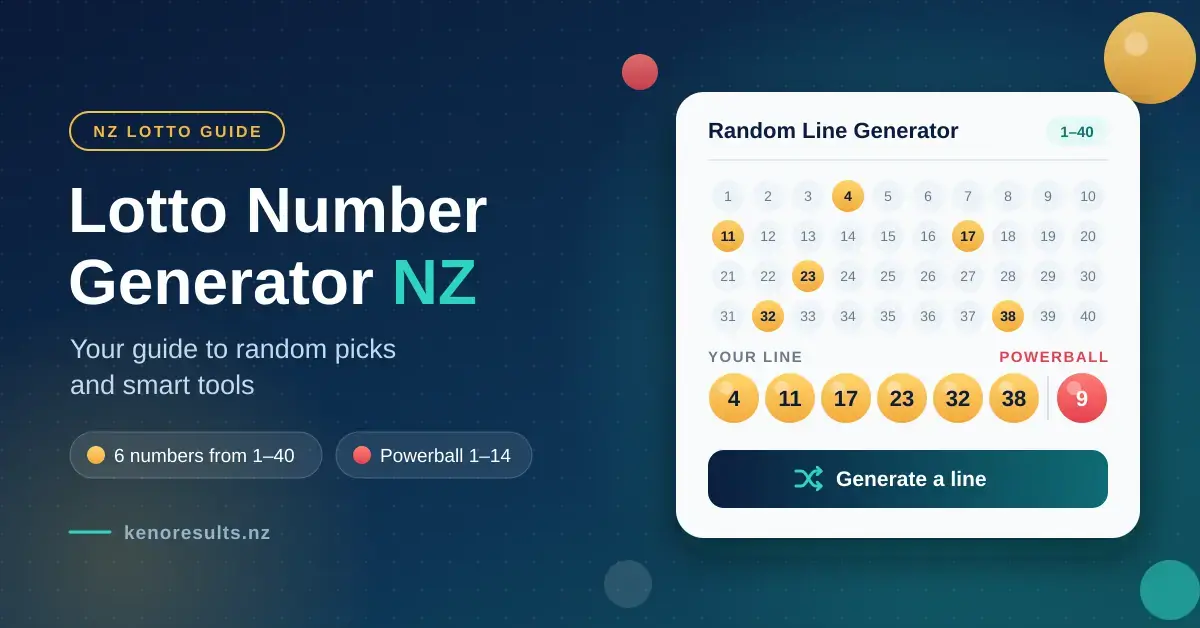
A lotto number generator is a program that selects a set of numbers from a fixed range at random, without repeating any number on the same line. For the main Lotto game it picks six unique numbers from 1 to 40. If Powerball is added, a second and completely independent draw appends one more number — and since 13 September 2026 that Powerball number is drawn from a pool of 1 to 14, up from the old 1-to-10 range. Any generator you rely on should now reflect the wider 1-to-14 pool.
Everyday software uses a pseudo-random number generator, or PRNG — a mathematical formula that produces results statistically indistinguishable from chance. Some independent tools go a step further and draw on physical randomness, such as atmospheric noise, to seed their picks. Either approach serves the same purpose: an unbiased line that mirrors the behaviour of the audited ball machine used on the televised draw.
How the randomisation logic works
When a generator runs, it moves through a short sequence of steps to assemble one legal, compliant Lotto line. The table below shows each stage and what it produces under the current rules.
| Processing stage | What the algorithm does | Rule it satisfies | Output |
|---|---|---|---|
| Initialise | Sets the number boundaries from 1 to 40 | Standard 40-ball Lotto field | Defines the playing field |
| Main selection | Draws six unique numbers from the pool | No repeated numbers on a line | Builds the base Lotto row |
| Powerball step | Switches to an independent 1-to-14 pool and draws one number | Current Powerball rules (since 13 Sep 2026) | Adds the single Powerball number |
| Finalise | Sorts the six main numbers in order | Standard ticket layout | Returns a ready-to-play line |
Why players choose random numbers over personal picks
The main reason Kiwi players reach for a generator is to remove the unconscious bias in their own choices. People are wired to look for meaning, so manual players cluster their numbers around birthdays, anniversaries and tidy patterns on the coupon. Birthdates in particular confine selections to 1 through 31, leaving the top of the board untouched.
This habit creates a real risk called prize dilution. Choosing popular numbers does not change your odds of matching the draw, but if a heavily chosen line does win, you are far more likely to split the First Division pool with other players who picked the same birthday pattern. A generator spreads its picks evenly across the whole 1-to-40 grid, which tends to produce lines few other people hold — relevant if you ever win and want to avoid sharing a prize.
Human bias versus algorithmic randomness
- The birthday ceiling: picking by dates ignores 32 to 40 entirely, skipping roughly a fifth of the board.
- Visual grid traps: straight lines, diagonals and boxes drawn on paper coupons create very common combinations that many players nationwide share.
- Even distribution: a generator treats 39 or 40 exactly the same as 7 or 11, naturally building lines that are rarely duplicated.
- Undivided prizes: because random lines sit outside common human preferences, they give you a better chance of an unshared payout if they do win.
Lucky Dip, Power Dip and Triple Dip explained
For most players the everyday face of a number generator is the Dip — a ready-made bundle of random lines produced instantly by the Lotto NZ terminal or the MyLotto site at the moment of purchase. Lotto NZ offers several Dip types that differ by which games they cover, and the official rules on how to play them are set out on the MyLotto how-to-play page.
Pricing is built from a per-line charge rather than fixed bundle names. A standard Lotto line costs $0.70, adding Powerball costs an extra $0.80 (so a combined Lotto-plus-Powerball line is $1.50), and a Strike line is $1.00. The minimum play is four lines, and the 2026 Powerball changes did not alter these prices. A Dip simply applies those charges to however many random lines you choose. For a fuller breakdown of multi-line bundle costs, see our guide to Lotto combo prices.
Dip Comparison
| Dip type | Games covered | Numbers generated per line | Per-line price (NZD) |
|---|---|---|---|
| Lucky Dip | Lotto only | 6 numbers from 1–40 | $0.70 |
| Power Dip | Lotto + Powerball | 6 numbers from 1–40, plus 1 Powerball from 1–14 | $1.50 |
| Triple Dip | Lotto + Powerball + Strike | 6 Lotto numbers, 1 Powerball, plus 4 Strike numbers | $1.50 Lotto/Powerball + $1.00 Strike |
Minimum play is four lines. Dips are sold in set line counts; the totals above scale with the number of lines you choose.
Hot, cold and mixed number tools
Many independent apps now sort their random output using historical draw data, usually labelled hot, cold or mixed. A hot filter favours numbers that have appeared most often; a cold filter favours numbers that have appeared least often or are on a long dry spell; a mixed filter blends the two on one line. A neutral generator ignores history altogether and relies on raw probability.
It is worth being clear about what these filters can do. Every draw is an independent event, so past frequency has no bearing on the next result — a number that has not appeared for months is no more “due” than any other. Hot and cold tools add a layer of engagement for people who enjoy tracking patterns, but they do not improve your odds. If you enjoy following the data, our breakdown of the most common Lotto numbers shows the long-run figures without overstating what they mean.
Saving and managing your lines on MyLotto
Moving your play to MyLotto makes random lines easier to keep track of, because every line you generate is tied to your verified account rather than a paper slip that can be lost. You can also save any combination you like as a Favourite and buy the exact same line again for a future draw with a single tap, which blends the convenience of a generator with the consistency of playing the same numbers.
The MyLotto platform also carries the player-protection tools required under New Zealand law. These include spending limits you set yourself, automatic checking of tickets bought online after each draw, small winnings credited straight to your account, and optional subscriptions so you do not miss a draw. Exact thresholds for automatic credits and the current limit options are shown in your account, so check them there rather than assuming a fixed figure.
Generators for Strike, Keno and Bullseye
The main Lotto generator is not the only format. Enthusiasts often retune their tools for other Lotto NZ games, each of which has its own structure, so the wrong settings will produce an invalid line.
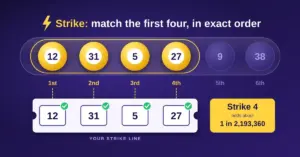
Lotto Strike asks you to match the first four balls of the main draw in the exact order they are drawn, which makes sequence — not just the numbers — the point of the game. Keno uses a far larger 1-to-80 board from which 20 numbers are drawn, four times a day at 10am, 1pm, 3pm and 6pm. Bullseye is a daily game built on a six-digit number rather than a grid.
How the settings change by game
- Lotto and Powerball: six numbers from 1 to 40 with no repeats, plus an optional Powerball number from 1 to 14.
- Strike: four numbers from 1 to 40, treated as an ordered sequence to match the first four balls drawn; see current Strike results for how draws land.
- Keno: a 1-to-80 field where you choose between 1 and 10 “spots”, against the 20 numbers drawn each game.
- Bullseye: a single six-digit number between 000000 and 999999, where the closest entry to the drawn number wins.
What the 2026 Powerball changes mean for your generator
Lotto NZ reshaped Powerball on 13 September 2026, and any generator or printed guide still using the old figures is now out of date. The core numbers to work from are:
- Wider pool: the Powerball number is now drawn from 1 to 14, not 1 to 10, so four more balls are in play.
- Longer jackpot odds: the odds of winning the Powerball jackpot on a single line moved from about 1 in 38.4 million to about 1 in 53.7 million. The Lotto-only odds (1 in 3,838,380) are unchanged — only the Powerball side lengthened. Our odds of winning Powerball page sets out every division.
- A new Division 8: matching two main numbers plus the bonus ball and the Powerball now pays a fixed $12.
- Bigger low-tier and jackpot amounts: Division 7 rose from $15 to $20, the starting jackpot went from $4 million to $5 million, and the cap rose from $50 million to $60 million.
- Same price: the $0.80 Powerball add-on per line did not change.
Common mistakes when using a lotto number generator
Generators are simple, but a few recurring errors trip players up. Avoiding them keeps the tool useful and your expectations grounded.
- Treating hot or cold numbers as predictions. Frequency tables describe the past; they cannot forecast the next draw, because each draw is independent.
- Using an outdated tool. Any generator that still caps Powerball at 10 is working from the pre-September-2026 rules and will never output the new numbers 11 to 14.
- Assuming randomness changes the odds. A generated line and a hand-picked line have identical odds; the only real benefit is avoiding shared, over-picked combinations.
- Chasing rollovers. Buying far more lines than usual because a jackpot has grown is a budgeting decision, not a strategy — the per-line odds are the same at $5 million or $60 million.
- Generating but not entering. A random line only counts once it is actually purchased and, ideally, recorded against your MyLotto account.
Responsible gambling
Lotto games are products of chance, and no generator, app or hot-and-cold filter can influence or predict which balls are drawn — the odds of the Powerball jackpot sit at roughly 1 in 53.7 million per line. This article is information only and is not advice to play. Entries should come only from money you can comfortably treat as entertainment, never from funds needed for rent, bills, food or savings, and the minimum age to buy a ticket in New Zealand is 18.
If gambling is causing stress for you or someone close to you, free and confidential help is available 24 hours a day from the Gambling Helpline on 0800 654 655 or by texting 8006, as part of the Safer Gambling Aotearoa programme.
Sources
- Lotto NZ (MyLotto) — Powerball changes from 13 September 2026
- Lotto NZ (MyLotto) — How to play Lotto, Powerball and Strike
- Lotto Amendment Rules 2026 — New Zealand Legislation
- NZ Herald — Lotto Powerball changes: bigger jackpots from September 13
- Stuff — Lotto has four new Powerballs: what it means for your odds
- Gambling Helpline Aotearoa
Frequently Asked Questions (FAQ)
What does a lotto number generator do in New Zealand?
It uses a randomisation algorithm to select a compliant Lotto line for you — six unique numbers from 1 to 40, with an optional Powerball number from 1 to 14 — removing the human bias that creeps into hand-picked numbers.
Does using a random generator improve my chances of winning?
No. A generated line has exactly the same odds as a line you pick yourself. Its only advantage is that it avoids common, heavily duplicated combinations, which reduces the chance of having to share a prize if you win.
What number range must an NZ Powerball generator use now?
Since 13 September 2026 a correct generator outputs six main numbers from 1 to 40 plus one Powerball number from 1 to 14. Tools still limited to a 1-to-10 Powerball are out of date.
Is a MyLotto auto-pick different from a retail Lucky Dip?
No. A random line generated in the MyLotto app and a Lucky Dip bought over a retail counter use the same audited random-selection system, so neither has an edge over the other.
Are winnings from randomly generated lines taxed in New Zealand?
No. Lottery prizes in New Zealand are treated as non-taxable windfalls by Inland Revenue, so winners keep 100% of their division payouts regardless of how the numbers were chosen.