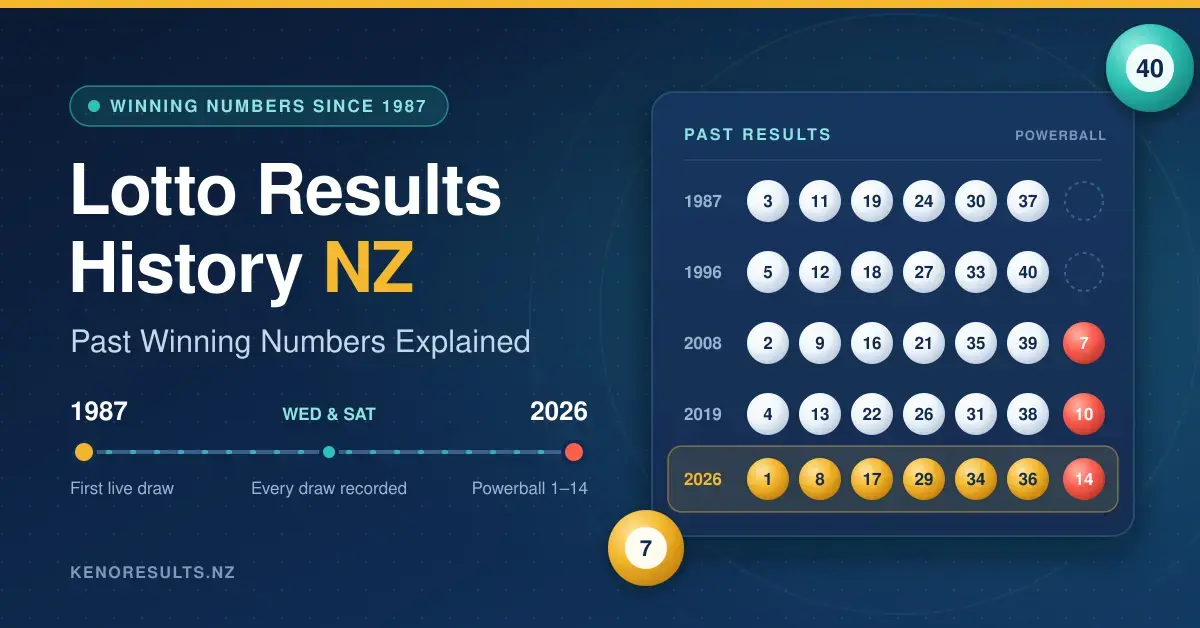
The lotto results history of New Zealand reaches back to 1 August 1987, when the first live draw awarded a Division 1 prize of $359,808. Since then Lotto NZ has recorded every winning combination from every Wednesday and Saturday draw, building a public archive that players use to check old tickets, settle syndicate questions and follow how the game has changed. This guide explains what that history contains, how to find official past results, the major rule changes that took effect in September 2026, and how to read decades of data without falling for common myths.
Key Facts
- First draw: 1 August 1987, with a Division 1 prize of $359,808
- Operator: Lotto NZ, the trading name of the New Zealand Lotteries Commission
- Main draw nights: Wednesday and Saturday
- Powerball pool: 1 to 14 since 13 September 2026 (previously 1 to 10)
- Powerball Division 1 odds: about 1 in 53.7 million per line
- Jackpot range: starts at $5 million, capped at $60 million
- Prize claim window: 12 months from the draw date
- Tax: New Zealand lottery prizes are paid tax-free
What does “Lotto results history” actually cover?
Lotto results history is the complete, dated record of every official draw outcome in New Zealand. For each draw it stores the six main numbers, the Bonus Ball, the Powerball number, the Strike sequence, and the cash dividend paid in each prize division. The archive is maintained by Lotto NZ, the trading name of the New Zealand Lotteries Commission, which has run the game since 1987.
Because the record is continuous, it serves several practical jobs at once: it lets you confirm an old ticket, it shows how often each number has been drawn, and it documents how the game itself has grown. If you only need the newest numbers, the latest Lotto results are published after each draw; the history is what you turn to when you want context across weeks, months or decades.
How New Zealand Lotto has changed since 1987
The core game has stayed recognisable: six main numbers are drawn from a pool of 1 to 40, followed by a seventh Bonus Ball. What has changed is the number of games stacked on top of that draw, which is why older results and newer results are not always directly comparable.
The first draws were a single Saturday event. A mid-week Wednesday draw was later added, doubling the number of results generated each week. Three add-on games then reshaped the archive: Strike in April 1993, the rolling Powerball jackpot in February 2001, and the daily Bullseye game in October 2009. Each addition created its own column of historical data.
Key milestones in the game’s history
The timeline below summarises the structural changes that most affect how you read the results archive.
| Year | Change | Effect on the results record |
|---|---|---|
| 1987 | Standard Saturday Lotto launches | Six numbers from 40, plus a Bonus Ball; first Division 1 prize of $359,808 |
| 1993 | Strike add-on introduced | Adds a separate record of the first four numbers in exact drawn order |
| 2001 | Powerball introduced | Adds a second drum and a rolling jackpot, lifting top prizes into the millions |
| 2009 | Bullseye daily game launches | Creates a separate daily six-digit results history |
| 2026 | Powerball overhaul (13 September) | Powerball pool grows to 1-14, a new Division 8 is added, and the jackpot range changes |
The 2026 Powerball changes every history-watcher should know
On 13 September 2026 Lotto NZ made the biggest change to Powerball since it launched, and it directly affects how you interpret the results archive. The Powerball pool expanded from 1-10 to 1-14, which lengthened the odds of a Division 1 win from roughly 1 in 38.4 million to about 1 in 53.7 million per line.
Alongside the longer odds, the starting jackpot rose from $4 million to $5 million and the maximum jackpot cap rose from $50 million to $60 million. A new Powerball Division 8 was added, paying a fixed $12 to anyone who matches two main numbers, the Bonus Ball and the Powerball, and several lower divisions were increased. The price per line stayed at $0.80.
The practical point for anyone studying history is this: a Powerball number above 10 cannot appear in any result before 13 September 2026, and the win-rate for each division shifted on that date. Treat pre-2026 and post-2026 Powerball data as two separate datasets rather than one continuous trend. For the mechanics in full, see the Powerball guide, and for the maths behind the new structure, the current Powerball odds.
How to access New Zealand’s past Lotto results
The authoritative source for past results is Lotto NZ’s own MyLotto platform, which lets you look up any historical draw by game and date. Using the official record matters because it carries the audited numbers and the exact dividends paid, rather than figures re-keyed by third-party scraper sites that can lag or contain errors.
What the official results archive includes
A single historical draw entry contains more than just the winning line. Expect to find:
- The six main numbers and the Bonus Ball for that draw date.
- The Powerball number and the Strike sequence, where played.
- The dividend paid in each division, and how many winning tickets shared it.
- Whether the draw was a standard draw or a declared Must Be Won draw.
Cross-referencing an old slip against this record also lets you review the prize divisions so you know exactly which tier a partial match falls into.
Record Powerball jackpots in NZ history
The results archive is where New Zealand’s biggest wins are documented. The largest single-ticket prize on record is $44.1 million, won in November 2016 by a Hibiscus Coast couple north of Auckland. It remains the benchmark single-line win in Lotto NZ history.
The first time the jackpot reached the then-cap of $50 million was in February 2020. No single line matched, so the top prize was shared by two tickets from Auckland and Hawke’s Bay, who took home about $25.1 million each. Under the current rules the jackpot can roll up to the $60 million cap, at which point a mandatory Must Be Won draw is declared. If nobody wins Division 1 that night, the prize rolls down to the next division with winners, which can turn lower-division tickets into unexpectedly large payouts.
Why do some numbers appear more often in the history?
Over thousands of draws, pure chance produces uneven frequency counts, so some numbers will show up more often than others in the archive. This is natural variance, not a pattern you can exploit. The mistaken belief that a number is “due” because it has not appeared recently is known as the Gambler’s Fallacy.
The drawing equipment has no memory. Each number in the main pool has the same chance of being drawn on every single draw, regardless of what happened last week or last year. Historical frequency tables are a fun way to choose a line, but they are a record of the past, not a forecast. If you enjoy that angle, the archive of most commonly drawn numbers and the wider historical Lotto statistics break the counts down in detail.
Keno and Bullseye: separate daily result histories
Not every number game in New Zealand follows the Wednesday and Saturday schedule. Keno and Bullseye run far more often and keep their own, separate result histories. Keno draws 20 numbers from a field of 80 and runs multiple draws every day, while Bullseye asks players to match a six-digit number and draws once each evening.
Despite the different formats, the claim and expiry rules are the same across all of these games, so the way you check a historical result is consistent. You can follow the daily Keno results and the latest Bullseye draws separately from the main Lotto archive.
Game Comparison
| Game | Draw frequency | How you win the top prize | Top prize | Claim window |
|---|---|---|---|---|
| Lotto + Powerball | Wednesday & Saturday | Six main numbers (plus the Bonus Ball for some divisions) and the Powerball from 1 to 14 | Jackpot from $5m, capped at $60m | 12 months |
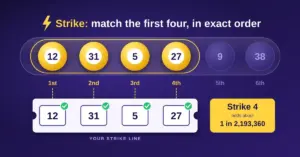
| Strike | Wednesday & Saturday | Match the first four main numbers in exact drawn order | Rolling cash jackpot | 12 months |
| Keno | Multiple draws daily | Match your chosen numbers against 20 drawn from 80 | Fixed prizes set by numbers picked and stake | 12 months |
| Bullseye | Once daily | Match a six-digit number | Rolling jackpot plus daily prizes | 12 months |
Checking an old ticket against the archive
A paper ticket is valid for exactly 12 months from its draw date, which is the main reason the results history is so useful day to day. If you find an old ticket in a drawer, you can match it against the archived draw before deciding whether a trip to a retailer is worth it.
New Zealand lottery prizes are paid tax-free, so a winning historical ticket is worth its full face-value dividend provided it is still inside the 12-month window. Anything left unclaimed after that window closes is forfeited. For the full process, including how larger prizes are paid, see the guide to claiming Lotto winnings.
Common mistakes when reading lotto history
The archive is only useful if you read it correctly. The most frequent errors are:
- Mixing pre- and post-2026 Powerball data. Combining results from the old 1-10 pool with the new 1-14 pool distorts any frequency or odds analysis.
- Chasing “overdue” numbers. A number that has not appeared recently is not more likely to appear next; every draw is independent.
- Trusting unofficial scrapers. Third-party sites can lag or mis-key dividends; verify against the official record.
- Assuming hot numbers improve your odds. Historical frequency does not change the fixed probability of any single draw.
- Forgetting the claim deadline. A winning ticket older than 12 months is no longer payable, no matter what the archive shows.
How draw integrity is protected
The randomness that underpins the whole archive is protected by independent oversight. Draws are conducted under audit, the ball sets and machines are inspected and periodically weighed to detect wear, and worn equipment is retired and replaced. Multiple machines and ball sets are rotated so no single set builds up a bias over time.
These controls are why the hot and cold streaks you see in the history are the product of ordinary probability rather than a flaw in the equipment. They also mean no software tool or statistical sorting method can predict which numbers will be drawn next.
Responsible gambling
Lotto, Powerball, Strike, Keno and Bullseye are games of chance, and the odds of a top-tier win are very long — about 1 in 53.7 million per line for Powerball Division 1. Reviewing historical results does not improve your chance of winning any future draw. Set a budget you are comfortable losing, keep lottery spending within your entertainment money, and never use funds meant for rent, food or bills.
You must be 18 or over to buy a ticket in New Zealand. If gambling is causing harm for you or someone you know, free and confidential help is available 24/7 from Gambling Helpline Aotearoa on 0800 654 655, or by texting 8006.
Sources
Frequently Asked Questions (FAQ)
Where can I find New Zealand’s full Lotto results history?
The official archive is on Lotto NZ’s MyLotto platform, where you can look up any past draw by game and date. It holds the winning numbers, Bonus Ball, Powerball, Strike sequence and the dividends paid in every division since the game began in 1987.
When was the first New Zealand Lotto draw?
The first live Lotto draw was held on Saturday 1 August 1987, with a Division 1 prize of $359,808. The game has run continuously ever since, later adding Strike in 1993, Powerball in 2001 and Bullseye in 2009.
What changed about Powerball in September 2026?
From 13 September 2026 the Powerball pool grew from 1-10 to 1-14, lengthening Division 1 odds to about 1 in 53.7 million per line. The starting jackpot rose to $5 million, the cap rose to $60 million, and a new Division 8 paying a fixed $12 was added.
How long do I have to claim a prize from an old ticket?
Paper tickets are valid for exactly 12 months from the draw date. You can check an old ticket against the results history at any time, but any prize left unclaimed after the 12-month window has closed is forfeited.
Are historical lottery wins taxed in New Zealand?
No. Lottery prizes in New Zealand are treated as tax-free windfalls, so winners keep the full face value of their division payout, regardless of when the ticket was bought within the valid 12-month period.