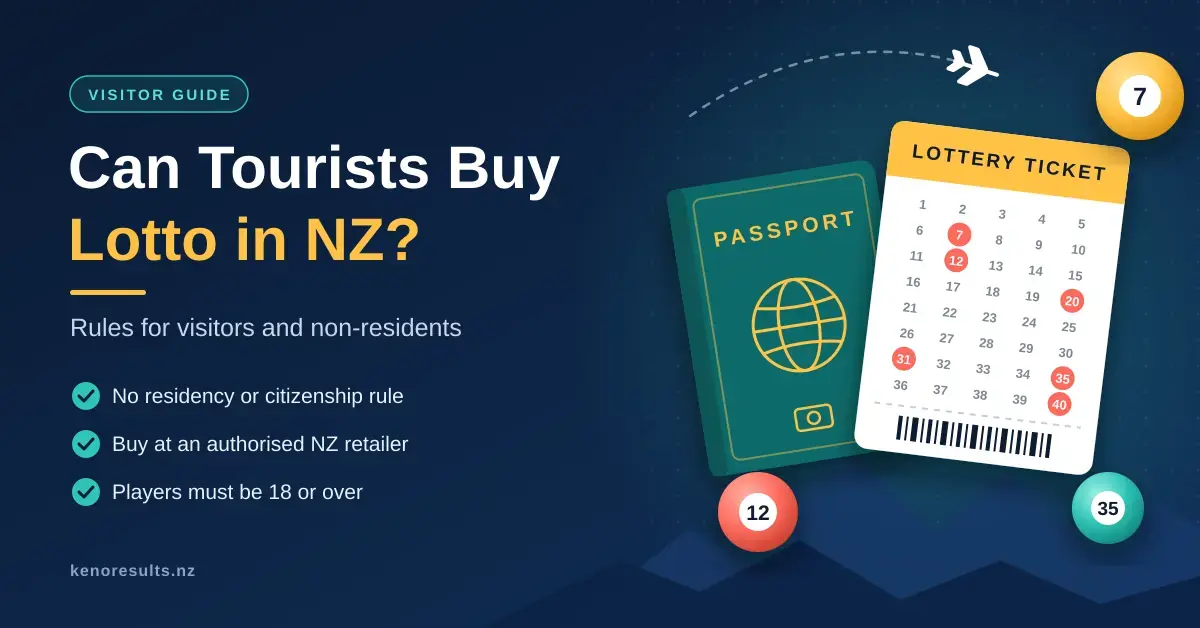
If you are visiting New Zealand on a holiday, a working-holiday visa, or a short business trip and a rolling Powerball jackpot is making headlines, it is natural to ask whether you are allowed to join in. In many countries, lottery laws include residency or citizenship rules that stop foreign nationals from playing or collecting the top prizes. New Zealand works differently. The games run by Lotto NZ (the trading name of the New Zealand Lotteries Commission) sit under the Gambling Act 2003, and that framework contains no nationality or residency barrier at the shop counter. In short, tourists and non-residents can legally buy tickets in person and claim any prize they win, as long as they follow a few clear rules.
Key Facts
- No residency rule in store: tourists and non-residents can buy and claim Lotto NZ products in person, whatever their nationality.
- Buy inside New Zealand: tickets must be purchased at an authorised retailer while you are physically in the country.
- Minimum age 18: the age limit applies to everyone, including visitors; carry photo ID.
- MyLotto is for residents: the online app needs a New Zealand address and payment details, so most tourists cannot register.
- Prizes are tax-free: New Zealand takes no tax from winnings, though your home country might.
- Claim within 12 months: every ticket expires 12 months after its draw date.
Can non-residents and tourists play Lotto in New Zealand?
Yes. Non-residents, tourists, and temporary visitors can legally buy and win Lotto NZ products. The law does not attach a citizenship or residency test to a physical lottery ticket. Whoever buys and holds a valid printed ticket is treated as the owner of the entries on it, whatever passport they carry.
This means a visitor from the United Kingdom, Canada, Australia, or anywhere else can walk into a local dairy (corner shop), buy a Lucky Dip or a hand-picked line, and hold a genuine, legally binding claim to any prize division they match — from a small lower-division win up to a multi-million-dollar Powerball jackpot.
Why a printed ticket counts as proof of ownership
A paper Lotto ticket works as a bearer document, similar to a cash voucher. Lotto NZ pays the person who presents the valid winning ticket rather than checking who originally bought it. That is why keeping the physical slip safe matters so much: if you lose it, you generally lose the claim. It is also why there is no requirement to prove where you live before you buy — the ticket, not your address, is the key.
Where and how tourists can buy tickets
The single most important rule for visitors is location: you must be physically inside New Zealand when you buy. Lotto NZ sells draw games through a network of more than 1,200 retail outlets, including dairies, supermarkets (such as Woolworths, New World, and PAK’nSAVE), petrol stations, and bookshops. You can find authorised Lotto retailers in all the main centres, including Auckland, Wellington, Queenstown, and Christchurch.
At the counter you can ask for a Lucky Dip (computer-generated numbers) or fill in a coupon by hand. Buying from overseas through third-party “concierge” or courier websites is a different matter: those services are not Lotto NZ, they add fees and risk, and buying across borders can breach the gambling laws of your own country. The safe, legitimate route is always an in-person purchase on New Zealand soil.
Rules to follow when buying in store
- Pay with accepted methods: terminals take New Zealand cash and local EFTPOS or debit cards. If you use an overseas card, watch for foreign-transaction fees from your bank.
- Mind the sales cut-off: like everyone else, you must buy before sales close at 7:30pm on draw nights. Lotto and Powerball are drawn on Wednesday and Saturday evenings.
- Write your name on the ticket: signing the back of the slip immediately helps establish that it is yours, which matters because the ticket is a bearer document.
- Protect the paper: keep it away from heat, sunlight, and moisture. A faded or damaged barcode can be hard to scan, and the printed slip is your only proof of the entry.
Age applies to everyone equally: the minimum age to buy any Lotto NZ product is 18, including visitors. Retailers can ask for photo ID, so carry your passport or driver licence if you look under age.
Why tourists usually cannot use the MyLotto app
Playing in store is easy, but playing online through MyLotto (the official website and app) is generally not an option for short-term visitors. MyLotto is built for New Zealand residents: creating an account requires a New Zealand residential address and relies on New Zealand payment details to fund and verify it. Because most tourists cannot satisfy those requirements, the practical answer is to stick to the in-store retail network while you travel.
There are sound reasons for this design. Restricting online accounts to local residents helps Lotto NZ avoid breaching the remote-gambling rules of other countries, keeps age and identity checks tied to local records, and keeps money moving through transparent domestic payment channels. The table below summarises how access differs by purchasing channel.
Comparison
| Buyer status | In-store purchase | MyLotto online | Right to claim a prize | Tax in New Zealand |
|---|---|---|---|---|
| NZ resident | Allowed | Allowed | Yes | Tax-free |
| Tourist in New Zealand | Allowed | Generally not available | Yes | Tax-free |
| Person overseas | Not possible (must be in NZ) | Not available | Valid only if holding a physical ticket bought in NZ | Tax-free |
How to claim a prize as a visitor
How you collect depends on how much you win. Small wins are paid instantly over the counter, while larger wins move to a formal process. The same rules apply to residents and visitors; the only extra step for a visitor is proving identity with a passport and nominating a bank account for payment. You can read more about claiming Lotto winnings for the full detail.
Small prizes (up to $1,000)
Prizes up to $1,000 can be paid straight away at any Lotto NZ retailer. The process is simple:
- The counter scan: hand your ticket to the operator, who scans the barcode and the terminal confirms the result.
- Instant payment: the retailer pays smaller amounts in cash or credits an accepted card, depending on the store and the amount.
- Free-ticket wins: some lower-division results pay out as a free ticket for the next draw rather than cash.
- Self-service scanners: many supermarkets and bookshops have a wall-mounted ticket checker so you can privately scan a batch of tickets to see which ones have won before you queue.
Larger prizes and jackpots (over $1,000)
Once a prize is above $1,000, a retailer can no longer hand you the money on the spot. You move to a formal claim, which a retailer or Lotto NZ customer centre can help start. Typically you will:
- Validate and keep the ticket: the ticket is scanned and set aside; sign it and keep a copy for your records, as Lotto NZ retains winning tickets.
- Complete a claim form: fill in Lotto NZ’s prize claim form with your details.
- Prove your identity and bank account: provide valid photo ID (a passport works for overseas visitors) and the bank account the prize will be paid into.
- Receive payment by transfer: larger prizes are paid by secure bank transfer, not cash. For very large wins (over $500,000, including jackpots), Lotto NZ contacts winners directly and pays by direct bank transfer.
If you win late in your trip, you do not have to claim before you fly home — but you must claim within the deadline explained further down, and you will need a bank account that can receive the transfer.
Do tourists pay tax on Lotto winnings in New Zealand?
New Zealand does not tax lottery prizes in the winner’s hands. The prize is treated as a tax-free windfall, so a visitor who wins receives the full face value — if you matched a $20 million Powerball jackpot, New Zealand does not withhold tax from the payout. Instead of taxing winners, the system collects a 5.5% lottery duty on ticket sales plus a problem-gambling levy, both paid by Lotto NZ rather than deducted from your prize.
One nuance is worth knowing: while the prize itself is tax-free, any income you later earn by investing the money (interest, dividends, rent) can be taxable — though that only affects people who are New Zealand tax residents. You can find more on whether you pay tax on Lotto winnings in New Zealand on the dedicated page.
What your home country might charge
Even though New Zealand takes nothing, your home country’s tax rules still matter:
- United States: US citizens and residents are taxed on worldwide income, so the IRS generally treats a foreign lottery prize as taxable income you must declare back home.
- United Kingdom and Australia: both treat lottery winnings as tax-free, so visitors from those countries usually face no extra tax on the win itself.
- Moving the money: if you carry NZ$10,000 or more in physical cash across the New Zealand border, you must complete a Border Cash Report for Customs. Most large winners avoid this by using a secure bank transfer instead of cash.
Tax rules differ by country and change over time, so confirm your own position with a qualified adviser before a large win.
The 12-month claim deadline
Every draw-based Lotto NZ ticket is valid for 12 months from the date of the draw. If you buy a ticket on a summer holiday and tuck it into your travel journal, you have one year to scan and claim it. After that window closes, the barcode can no longer be redeemed, the ticket loses its value, and unclaimed prize money goes back into the prize pool. Because visitors often travel on after buying, it is worth checking tickets before you leave the country — a quick scan at a self-service checker or a retailer counter takes seconds.
Understanding the odds and playing responsibly
Lotto is a game of chance, and the top-prize odds are long. Standard Lotto draws six numbers plus a bonus ball from 1 to 40, and Powerball adds a separate ball. Since the rules changed on 13 September 2026, that Powerball ball is drawn from 1 to 14 (previously 1 to 10), which lengthened the odds of a Division 1 Powerball win to about 1 in 53.7 million per line (up from about 1 in 38.4 million). The same change lifted the jackpot floor to $5 million, raised the cap to $60 million, and added a new lower division. You can read more about Powerball odds to see how each division compares.
No shop, lucky number, or Lucky Dip can change those odds — each draw is independent and random. Treat a ticket as a small bit of holiday fun funded from spare spending money, not as a way to make money.
Common mistakes visitors make
- Buying from overseas “courier” sites: these are not Lotto NZ, charge extra, and may breach your home country’s rules. Buy in person in New Zealand.
- Assuming they can register online: MyLotto is set up for residents, so plan to buy in store rather than relying on the app.
- Losing or damaging the ticket: because it is a bearer document, a lost or unreadable slip usually means a lost claim. Photograph it and store it safely.
- Forgetting the deadline: a ticket left in a suitcase for more than 12 months is worthless. Check it before you fly home.
- Chasing a rollover: spending more because a jackpot has grown does not improve your odds; the chance per line is fixed.
- Not planning for a payout: a large prize is paid by bank transfer, so you will need an account that can receive it.
The bottom line for visitors
Tourists and non-residents can buy Lotto in New Zealand and keep every cent of any prize, provided they buy a physical ticket in person at an authorised retailer while in the country and are at least 18. Online play through MyLotto is effectively limited to residents. Small prizes up to $1,000 are paid instantly in store; larger wins need a claim form, a passport, and a bank account for transfer. All prizes are tax-free in New Zealand, every ticket expires 12 months after its draw, and the odds remain long — so keep it light and within your travel budget.
Responsible gambling
This article is general information for visitors, not gambling advice, and nothing here improves your chance of winning. Lotto products are a form of gambling and should only be funded from money you can afford to lose. Warning signs include spending travel money meant for food or accommodation on tickets, increasing your spend to chase a rollover, or feeling stress around draw results. In New Zealand, free and confidential help is available 24/7 from the Gambling Helpline on 0800 654 655 (or text 8006), and you can read more on our responsible gambling page. The minimum age to take part is 18.
Sources
Frequently Asked Questions (FAQ)
Can tourists buy Lotto in NZ at retail stores?
Yes. Tourists, holidaymakers, and non-residents can legally buy any Lotto NZ product in person at an authorised retailer anywhere in New Zealand. There is no citizenship or residency requirement at the counter; you just need to be in the country and at least 18.
Can non-residents win and claim Lotto NZ prizes legally?
Yes. A New Zealand lottery ticket is a bearer document, so anyone holding a valid winning ticket can claim the prize regardless of nationality. For wins over $1,000 a visitor completes a claim form and shows a passport, and the prize is paid by bank transfer.
Can a visitor buy tickets online through MyLotto?
Generally no. MyLotto is designed for New Zealand residents and requires a New Zealand residential address and local payment details to register. Short-term visitors usually cannot complete sign-up, so buying in store is the reliable option.
Do tourists pay tax on Lotto winnings in New Zealand?
No. New Zealand does not tax lottery prizes, so visitors receive the full amount. However, your home country may tax a foreign lottery win — the United States, for example, generally does — so check your own tax rules before a large win.
How long does a visitor have to claim a winning ticket?
You have 12 months from the draw date to claim. After that the ticket can no longer be redeemed and the prize returns to the pool, so check and claim tickets before this deadline, ideally before you leave the country.