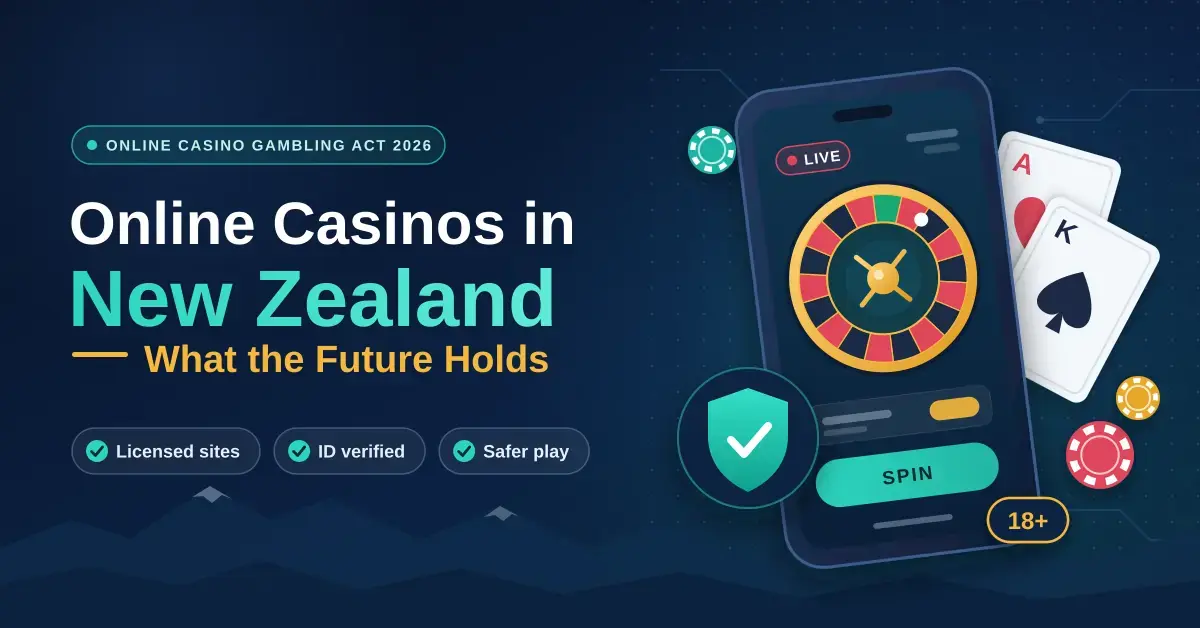
The future of online casinos in New Zealand is no longer guesswork. On 1 May 2026 the Online Casino Gambling Act 2026 came into force, creating the country’s first licensing system for internet casino gambling and putting a regulated market on a firm timetable. This guide explains what the new law changes, when licensed sites are expected to go live, the protections now built in for players, the taxes operators will pay, and how technology trends such as cryptocurrency, live dealer games and artificial intelligence fit into the new picture.
Key Facts
- Law: Online Casino Gambling Act 2026 (in force 1 May 2026; regulations from 3 July 2026)
- Regulator: Department of Internal Affairs (DIA)
- Licences available: up to 15 (maximum 3 per operator)
- Licence term: up to 3 years, renewable once for up to 5 more
- Minimum age: 18, with mandatory identity and age verification
- Credit cards: banned for online casino gambling
- Advertising: prohibited now; licensed operators may advertise with restrictions from 1 June 2027
- Market fully operational: expected 2027
What is the Online Casino Gambling Act 2026?
The Online Casino Gambling Act 2026 is New Zealand’s first dedicated law for licensing and regulating online casino gambling. Before it, there was no legal way for a casino website to operate from within New Zealand or to be licensed to serve New Zealanders; Kiwis who played online did so almost entirely on offshore sites that no local authority oversaw. The Act, administered by the Department of Internal Affairs (DIA), sets up a tightly capped, licensed market with enforceable rules on consumer protection, harm minimisation and advertising.
“Online casino gambling” under the Act means gambling at a distance through a communication device — for example, random-number-generator games such as online pokies, virtual table games, and bets on computer-simulated sports. It deliberately does not cover sports and racing betting, Lotto, Keno or other lottery products, which stay under their existing rules. If you want the background on how land-based machines fit into all this, the overview of the New Zealand pokies market is a useful companion read.
When will licensed online casinos launch in New Zealand?
Licensed online casinos are being phased in through 2026 and 2027 rather than switching on overnight. The DIA has published a staged timetable: the Act commenced on 1 May 2026, the supporting Online Casino Gambling Regulations took effect on 3 July 2026, and the competitive licensing process ran across the second half of 2026. The market is expected to be fully operational in 2027.
The practical turning point for players is 1 December 2026. From that date, any provider that has not lodged a licence application must stop offering online casino gambling to people in New Zealand. Operators with an application still under consideration may keep running, but without advertising, until a decision is made. The table below sets out the key milestones.
Licensing Timeline
| Date | Milestone |
|---|---|
| 1 May 2026 | Online Casino Gambling Act 2026 comes into force |
| 3 July 2026 | Online Casino Gambling Regulations take effect |
| 17 Jul – 14 Aug 2026 | Expression-of-interest stage (now closed) |
| 29 September 2026 | Licence auction (ascending-clock format) |
| October 2026 | Successful bidders may submit full licence applications |
| 1 December 2026 | Providers without a licence application must stop serving NZ players |
| 1 June 2027 | Advertising exemption begins; market expected fully operational in 2027 |
How many licences are available and who can hold one?
Only up to 15 online casino licences will exist, and that cap is a hard statutory limit. Each licence covers a single brand and its platforms, lasts up to three years, and can be renewed once for up to five further years. To stop the market concentrating in a few hands, no single operator may hold — or have significant influence over — more than three licences.
Getting a licence is a three-stage process run through the government’s electronic tender service. First, operators submitted an expression of interest (the paid application window closed on 14 August 2026). Next came an ascending-clock auction on 29 September 2026, in which the price rose in rounds and bidders dropped out until the available licences were allocated. Winning the auction does not hand over a licence by itself: successful bidders pay the auction-determined amount and then submit a full application, including a business plan and strategies for advertising, consumer protection and harm minimisation, from October 2026. Applicants also had to show access to substantial capital, reported at around NZ$7.5 million, which keeps the field to well-resourced operators.
What taxes and levies will licensed operators pay?
Licensed operators face several charges, which is part of why the regime is restricted to serious businesses. They pay a gambling duty to Inland Revenue — reported at 16% of gross gambling revenue (the money kept after prizes are paid) — along with levies collected by the regulator, including a problem-gambling levy that funds harm-prevention and treatment services. Standard GST and the one-off auction price also apply. These costs do not fall directly on players, but they explain why only a tightly controlled set of operators will be able to run a compliant New Zealand casino.
What player protections and responsible-gambling rules apply?
Player protection is built into the licence conditions rather than left to each operator’s goodwill. Licensed sites must verify that every customer is at least 18, using robust digital identity and age checks before play. Several safeguards are mandatory:
- Spending controls: configurable deposit, spend and session limits, plus breaks in play and time-outs.
- Reality checks: pop-up alerts after 60 minutes of continuous play.
- Cooling-off: a 24-hour delay before any increase or removal of a limit takes effect, so decisions cannot be made in the heat of the moment.
- Design limits: autoplay and playing multiple slots at once are prohibited.
- Payment safety: credit cards and credit-linked payment methods are banned for online casino gambling.
If you are weighing how you fund an account, our explainer on payment methods at online casinos covers the practical options, and the site’s responsible gambling resources are worth reading before you play.
How will advertising be regulated?
Online casino advertising to New Zealanders is prohibited right now and will only be permitted — with strict limits — once the licensed market is running, with the advertising exemption beginning 1 June 2027. Even then, the rules are far tighter than in many overseas markets. Expected restrictions include no affiliate marketing, no paid or celebrity endorsements, no sponsorships, no advertising during or within 30 minutes of a live broadcast, and no content that portrays gambling as an investment, an income source or a way out of financial trouble. Ads may not target under-18s or run where more than one in five of the likely audience is under 18. The regulator can issue takedown notices and seek penalties reported at up to NZ$5 million for unlawful advertising. This legal position is also why reputable New Zealand sites do not publish ranked casino bonus lists.
Which technology trends are shaping the future?
Beyond the law, four technology trends are set to define how licensed online casinos look and feel. None of them changes your odds of winning — house games are built with a mathematical margin — but they shape the experience.
Cryptocurrency payments
Cryptocurrency is often promoted for its speed and privacy, but its role in New Zealand’s licensed market is uncertain. Because licence conditions require strong identity verification and ban credit-linked payments, anonymous crypto deposits sit awkwardly with the rules, and operators must meet anti-money-laundering obligations. Crypto’s price can also swing sharply between deposit and withdrawal. For a plain-language look at the mechanics and risks, see our guide on how to gamble with crypto online.
Live dealer games
Live dealer games stream a real human dealer and physical table to your screen in real time, and they remain among the most popular online formats for blackjack, roulette and baccarat. Expect higher-quality streaming, more game variety and hybrid formats that blend classic table play with game-show-style features as bandwidth and studio technology improve.
AI and personalisation
Artificial intelligence and machine learning — software that learns patterns from data — are used to tailor which games and messages a player sees. Used responsibly, the same technology is increasingly aimed at safety: spotting signs of harmful play, prompting breaks and flagging accounts that breach their own limits. New Zealand’s harm-minimisation rules push operators toward that protective use rather than pure marketing.
Virtual reality casinos
Virtual reality (VR) casinos aim to recreate a physical venue in a 3D space you explore with a headset, including social interaction with other players. For now this remains niche in New Zealand: headset ownership is limited and the licensing framework is focused on conventional web and app play, so VR is a longer-term possibility rather than an imminent shift.
What happens to offshore and unlicensed casinos?
Offshore casinos without a New Zealand licence are being pushed out of the market, not grandfathered in. From 1 December 2026, providers that have not applied for a licence must stop serving New Zealanders, and advertising by unlicensed operators is already prohibited. A player who gambles on an unlicensed site does not commit an offence, but they give up the protections the new regime provides: there is no guaranteed age verification, no mandatory deposit limits, no local complaints process and no certainty of being paid. The safest path is to use operators that appear on the DIA’s licensed list once it is published. Our overview of online casinos used by New Zealand players gives more context on the shift.
What common mistakes do New Zealand players make?
The most common mistake is assuming an offshore site is “regulated” because it looks professional or claims a foreign licence. A few errors recur:
- Trusting a logo: a Curaçao or other offshore badge is not a New Zealand licence and offers Kiwis little practical protection.
- Chasing bonuses: treating a “welcome offer” as free money while ignoring wagering requirements and withdrawal limits.
- Ignoring the tools: not setting deposit or session limits even when a site offers them.
- Believing in systems: thinking a betting pattern, demo-play “practice” or a hot streak improves the odds. It does not — the house margin is fixed.
- Skipping identity checks: using sites that let you deposit without verification, which is often a sign of weak consumer safeguards.
Who does the regulated market suit?
The regulated market suits adults who want to play online casino games with clear consumer protection and are comfortable treating it strictly as paid entertainment. Players who value mandatory limits, dispute resolution and verified operators gain the most. It is not suitable for anyone under 18, anyone using borrowed or credit funds, or anyone hoping to make money — the design of casino games means the operator keeps an edge over time. If your interest is really in number-draw games rather than casino products, you may prefer reading about how technology has impacted Keno gaming instead.
Responsible Gambling Disclaimer
This article is general information about New Zealand’s online casino regulations, not legal, financial or gambling advice, and it does not encourage you to gamble. Gambling involves real risk of financial loss, and no strategy, demo mode or technology improves your long-term odds against house games. You must be 18 or over. If gambling is affecting you or someone you know, free, confidential, 24/7 support is available from Gambling Helpline Aotearoa on 0800 654 655 or by texting 8006. For the official rules and the current list of licensed operators, check the Department of Internal Affairs.
Sources
Frequently Asked Questions (FAQ)
Are online casinos legal in New Zealand now?
Yes, within a new licensed system. The Online Casino Gambling Act 2026 came into force on 1 May 2026 and allows a capped number of licensed operators to offer online casino gambling to New Zealanders. The market is being phased in, with licensing completed through late 2026 and full operation expected in 2027.
How many online casino licences will New Zealand issue?
Up to 15 licences will be available, and no operator may hold more than three. Each licence covers one brand, lasts up to three years and can be renewed once for up to five more years. The licences were allocated through an expression-of-interest stage and an ascending-clock auction held on 29 September 2026.
What is the minimum age to use a licensed online casino?
You must be at least 18. Licensed operators are required to verify identity and age with robust digital checks before allowing play, so you can expect to confirm who you are when you open an account.
Can I still use offshore casino sites?
Playing on an offshore site is not itself an offence for the individual, but unlicensed providers must stop serving New Zealanders from 1 December 2026, and they cannot legally advertise here. Offshore sites also lack the mandatory limits, verification and complaints processes that licensed New Zealand operators must provide.
Does the new law cover Lotto, Keno or sports betting?
No. The Online Casino Gambling Act 2026 covers online casino games such as online pokies and virtual table games. Lotto, Keno, other lottery products and sports and racing betting remain under their own existing rules and are not part of this licensing regime.