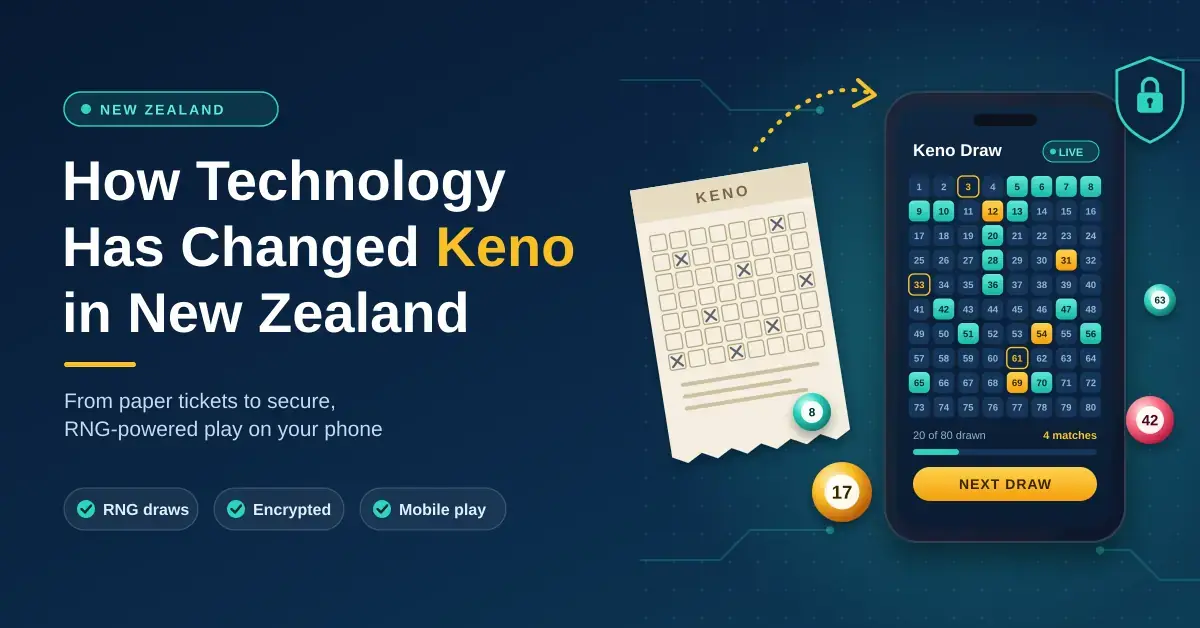
Keno is one of the simplest number games you can play: you choose a handful of numbers, a draw selects 20 at random from a pool of 80, and your prize depends on how many you match. The game itself has barely changed in centuries, yet the way New Zealanders play it looks almost nothing like it did a generation ago. Technology has moved keno from smoky halls and paper tickets onto phones, secured the money behind it, and opened up formats that were impossible on a physical board. This guide explains exactly what changed, how the technology works, and what it means for players here.
Key Points
- What changed: keno moved from paper tickets and in-venue draws to browsers and mobile apps, playable anywhere.
- Fairness: a random number generator (RNG) now draws the 20 numbers, replacing physical balls; regulated RNGs are independently audited.
- Security: SSL/TLS encryption, two-factor authentication and secure payment gateways protect your account — but not your odds.
- More formats: themed games, optional multipliers, multi-draw and quick-pick entries exist because the game is now digital.
- In New Zealand: Keno is a Lotto NZ game played via MyLotto, run under the Keno Rules 2025 and sitting outside the Online Casino Gambling Act 2026. You must be 18+.
What is keno and where did it come from?
Keno is a lottery-style game in which a draw picks 20 numbers at random from 1 to 80, and players win by matching some of those numbers on their own selection. In New Zealand it is run by Lotto NZ (the New Zealand Lotteries Commission) and can be played at retailers or online through MyLotto. You choose up to 10 numbers — called spots — and the more of your spots that come up, the larger the prize.
Popular accounts claim keno is thousands of years old, often tying it to a Han-dynasty figure who supposedly used a lottery to fund an army. Historians treat that as legend: the game’s documented history is far more recent, and casino keno with numbered balls or screens is a modern creation. What is clear is that the format travelled with Chinese emigrants across the Pacific and was later adapted for lottery and casino play. If you want the ground rules before reading on, the site’s guide to how to play keno covers the basics in order.
How has technology changed the way people play keno?
The single biggest change is access: you no longer need to be standing in a venue to play. Before the internet, keno meant visiting a club, pub or casino, buying a paper ticket at a counter and waiting for the next in-room draw. Today the same game runs in a browser or an app, so a player can enter a draw from home, on a commute or during a lunch break.
Mobile and online play
Smartphones and tablets turned keno into an on-demand game. Draws run frequently throughout the day, and an app can store your favourite numbers, auto-renew an entry across several draws, and notify you of results without you checking a screen. For New Zealand players, MyLotto accounts also handle age and identity verification and keep a record of spending in one place.
Faster, clearer results
Results that once had to be read off a board or printed sheet are now published instantly online. You can look up the latest keno results the moment a draw closes, and check an old ticket against an archive rather than relying on a posted notice. Digital number pickers and pattern tools — such as the site’s keno tools — also exist because the game is now data-driven, though they do not change the odds of any single draw.
How do online keno games stay fair and random?
Online keno draws are produced by a random number generator (RNG), which is software designed to output unpredictable number sequences. An RNG replaces the physical ping-pong balls or bubble machine used in a venue: instead of air blowing balls into a tube, an algorithm selects the 20 winning numbers so that every number has an equal chance each draw.
For a regulated game, the RNG is not simply trusted on the operator’s word. It is tested by independent laboratories and audited to confirm the output is statistically random and cannot be predicted or influenced. In New Zealand, Keno is run under the official Keno Rules 2025, which set out how draws must be conducted. The key point for players is that no past result makes a future number ‘due’ — a true RNG has no memory, so chasing numbers that ‘haven’t come up’ has no effect on your chances. That is also why no tool or system can tilt the odds; for realistic expectations, see the site’s notes on keno strategy.
How is your money and data kept secure online?
Reputable keno platforms protect your details with layered security technology. The most important pieces are encryption and account verification:
- SSL/TLS encryption: Secure Sockets Layer (and its modern successor, Transport Layer Security) scrambles the data travelling between your device and the site, so card numbers and personal details cannot be read if intercepted. A padlock icon and an ‘https’ web address signal it is active.
- Two-factor authentication (2FA): after you enter a password, the site asks for a second proof of identity — usually a one-time code sent to your phone or generated by an app. Even if someone steals your password, they cannot log in without that second factor.
- Encrypted payments: deposits and withdrawals are processed through secure payment gateways rather than the game screen, keeping financial data separated from gameplay.
These tools protect the account; they do not change the odds or guarantee a return. If you are comparing how different sites handle deposits and withdrawals, the site’s overview of payment methods at online casinos is a useful companion read.
What new keno formats has technology made possible?
Digital platforms removed the limits of a physical board, so keno now comes in more shapes than it ever could in a hall. Software lets operators change themes, speeds, stakes and bonus features cheaply, which has widened the game’s appeal well beyond its traditional audience.
- Themed and animated games: studios dress keno in graphics and sound — sport, film, seasonal or pop-culture styling — to make draws more engaging.
- Optional multipliers: New Zealand Keno offers an optional multiplier add-on. If you choose it and win, a multiplier value drawn for that game increases your prize. It costs extra and does not improve your odds of matching numbers.
- Multi-draw and quick-pick entries: you can enter the same numbers across several consecutive draws, or let the system pick numbers for you, in a couple of taps.
- Instant and hybrid formats: online instant games and fast-cycle draws borrow keno’s pick-and-match mechanic for players who want a quicker result.
The table below sums up how the land-based and online experiences compare.
Then vs Now: Keno Compared
| Feature | Land-based keno (before) | Online keno (now) |
|---|---|---|
| Where you play | Club, pub or casino, in person | Browser or app, anywhere |
| Ticket | Printed paper slip | Digital entry stored in your account |
| The draw | Physical balls / bubble machine | Random number generator (RNG) |
| Results | Read off a board or sheet | Published online instantly |
| Formats | Standard game only | Themed games, multipliers, multi-draw, quick pick |
| Support | Counter staff; email/letter | Live chat and in-app help in seconds |
| Safer-play tools | Very limited | Deposit limits, alerts, self-exclusion in-account |
If you enjoy the mechanics behind these number games, the site also looks at the design principles behind number-based games.
How have support and responsible-gambling tools improved?
Technology has sped up help and, just as importantly, built in safer-play controls. Where a query once meant a letter or an email answered days later, most platforms now offer live chat and in-app help that respond in seconds, often backed by searchable help centres and chatbots for routine questions.
The same account systems that enable instant play also enable player protection. Regulated operators let you set deposit limits, spending alerts, time reminders, cool-off periods and self-exclusion directly in your account — tools that simply were not possible with a paper ticket at a counter. Transaction histories make it easy to see exactly what you have spent, which supports informed, limited play.
Is online keno legal and regulated in New Zealand?
Yes — playing Keno online through Lotto NZ’s MyLotto is legal and regulated, and you must be 18 or over. Keno is a New Zealand lottery product overseen by the Department of Internal Affairs and run under the Keno Rules 2025, separate from private casino operators.
This matters because of a recent law change. The Online Casino Gambling Act 2026 took effect on 1 May 2026 and created New Zealand’s first licensing regime for online casino games — covering random-number-generator casino games, online table games and bets on simulated sports. Lotto NZ products, including Keno, sit outside that casino regime. Advertising unlicensed offshore online casinos to New Zealanders has also been prohibited since 1 May 2026, so be cautious of overseas sites marketing ‘keno’ outside the official channels. For the bigger picture, see the site’s look at the future of online casinos in New Zealand.
Common mistakes players make with online keno
The convenience of online play introduces its own pitfalls. The most common mistakes are easy to avoid once you know them:
- Believing a system beats the RNG. Hot numbers, cold numbers and ‘due’ numbers are patterns in past data only; each draw is independent, so no selection method raises your odds.
- Playing on unofficial sites. Offshore pages advertising keno may be unlicensed in New Zealand. Stick to Lotto NZ for the official game.
- Ignoring the padlock. Never enter payment details on a page without an ‘https’ address and a valid security certificate.
- Treating the multiplier as an edge. It can raise a winning prize but costs more and does nothing for your chance of matching numbers.
- Not setting limits. The speed of online draws makes it easy to spend more than intended; deposit and session limits exist for exactly this reason.
Who does online keno suit?
Online keno suits players who want a simple, low-commitment game they can dip into anywhere, and who value fast results and clear records over the social atmosphere of a venue. If you prefer the ritual of a counter and a paper ticket, retail play still exists. Readers curious about how its audience has shifted can explore the site’s piece on keno’s popularity across different demographics in New Zealand. Whichever you choose, keno remains a game of chance: it is entertainment, not an income.
Responsible Gambling in New Zealand
This article is general information about keno and the technology around it, not gambling advice. Keno is a game of chance; no app, tool or strategy improves your odds of winning, and you should only ever play with money you can afford to lose. You must be 18 or over to play Keno through Lotto NZ.
If gambling is causing harm to you or someone you know, free, confidential help is available 24/7 in New Zealand. You can contact the Gambling Helpline Aotearoa on 0800 654 655 or by texting 8006, and the Problem Gambling Foundation of New Zealand on 0800 664 262. Both offer support at no cost. The Department of Internal Affairs regulates gambling in New Zealand.
Sources
- Lotto NZ (MyLotto) — Keno
- Keno Rules 2025 — New Zealand Legislation
- Department of Internal Affairs — Gambling in New Zealand
- Department of Internal Affairs — Online Casino Gambling Act 2026
- Gambling Helpline Aotearoa
- Problem Gambling Foundation of New Zealand
- Microsoft — What is two-factor authentication (2FA)?
Frequently Asked Questions (FAQ)
Who runs Keno in New Zealand?
Keno in New Zealand is run by Lotto NZ, trading name of the New Zealand Lotteries Commission. You can play it at authorised retailers or online through a MyLotto account. It is overseen by the Department of Internal Affairs and run under the Keno Rules 2025, which is different from privately operated online casinos.
Are online keno results genuinely random?
Yes. Online draws use a random number generator, which is software that produces unpredictable sequences so that every number has an equal chance in each draw. For regulated games the generator is independently tested and audited. Because the system has no memory, past results do not influence future draws, so no number is ever ‘due’.
Can I play keno on my phone in New Zealand?
Yes. Keno can be played online through MyLotto on a smartphone or tablet, letting you enter draws, store favourite numbers and check results from anywhere. You must be 18 or over and have a verified account. Playing through the official channel keeps you within New Zealand’s regulated, legal game.
Does the Online Casino Gambling Act 2026 affect keno?
Not directly. The Online Casino Gambling Act 2026, in force since 1 May 2026, licenses online casino games such as RNG casino games, table games and simulated-sports betting. Lotto NZ products, including Keno, sit outside that casino regime. The law did, however, prohibit advertising unlicensed offshore casinos to New Zealanders.
What technology protects my details when I play keno online?
Reputable platforms use SSL/TLS encryption to scramble data sent between your device and the site, two-factor authentication to confirm it is really you logging in, and secure payment gateways to protect card details. Look for an ‘https’ address and a padlock icon. These measures guard your account but do not change your odds of winning.