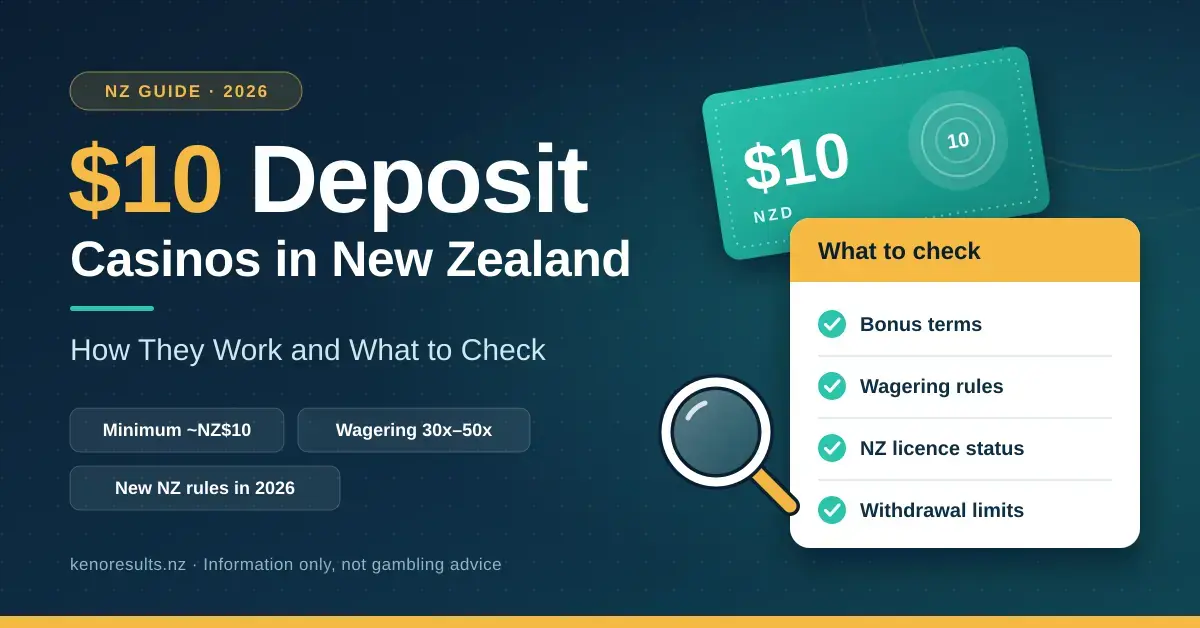
A “$10 deposit casino” is simply an online casino that lets you fund an account with a minimum of about NZ$10 and start playing from there. It is not a special type of casino or a mark of quality — it only describes the lowest amount the site will accept. This guide explains, in plain terms, how a $10 deposit actually behaves once bonuses and wagering rules are applied, what New Zealand’s 2026 online casino laws mean for these sites, and the practical checks worth making before you hand over any money. It is information only, not encouragement to gamble or advice on where to play.
Key Points
- It only means the minimum deposit is ~NZ$10. It is not a casino type or a sign of quality.
- The bonus is smaller than the headline. A “100% up to $1,000” offer pays just $10 on a $10 deposit, and wagering requirements (often 30x–50x) decide what, if anything, becomes withdrawable.
- New Zealand’s rules changed in 2026. The Online Casino Gambling Act 2026 is in force; offshore sites may operate only in a transition period and may not advertise to New Zealanders.
- No NZ-licensed online casinos exist yet. Licensed operators will appear on a public DIA register and show a registration icon from 2027.
- Credit-card deposits will be banned for licensees, and all licensed sites must offer deposit limits, time-outs and self-exclusion.
- Set a budget first, read the full terms, and never treat gambling as income. You must be 18 or over to play.
What a $10 deposit casino actually is
A $10 deposit casino is an online gambling site whose minimum deposit is around NZ$10, rather than the NZ$20, NZ$50 or higher minimums some operators set. The appeal is control: you can see how a site handles sign-up, deposits, games and withdrawals while risking only a small amount. The label says nothing about licensing, fairness, payout speed or customer service — two sites can both accept $10 and be worlds apart in quality. Treat the minimum deposit as one small detail, not a reason to choose a casino.
How a $10 deposit really works
The key thing to understand is that a $10 deposit rarely stretches as far as the marketing suggests, because bonus maths and wagering rules sit between your deposit and any withdrawable cash. Breaking the mechanics down avoids the most common disappointment.
The welcome bonus is smaller than the headline
Welcome offers are written to look large. A “100% match up to $1,000” does not give a $10 depositor $1,000 — it matches what you put in, so a $10 deposit earns a $10 bonus, giving $20 to play with. The “up to” figure only matters if you deposit that much. Some sites instead cap small-deposit bonuses or exclude the lowest tier from a promotion altogether, so the real value depends entirely on the terms attached to your actual deposit.
Wagering requirements decide what you keep
Wagering requirements are the total amount you must bet before bonus funds (and often the winnings from them) can be withdrawn as cash. They are usually written as a multiplier. A 30x requirement on a $10 bonus means $300 of bets; applied to deposit plus bonus ($20), it means $600. Welcome bonuses commonly run from 30x to 50x, though fairer cash bonuses sit lower. If you cannot meet the requirement before the bonus expires, the bonus and anything won from it are typically removed. Always check whether the multiplier applies to the bonus alone or to deposit plus bonus — it roughly doubles the work.
Game weighting, bet caps and time limits
Not every game counts the same toward wagering. Slots often contribute 100%, while table games and live-dealer games may count 10% or less, or not at all. Many bonuses also impose a maximum bet while the bonus is active and a deadline (sometimes as short as seven days). Breaking a bet cap or missing the deadline can void the bonus, so these clauses matter as much as the headline percentage.
The New Zealand rules you need to know in 2026
New Zealand’s online casino market changed fundamentally in 2026, and any older “best $10 casino” list written before this should be read with caution. The Online Casino Gambling Act 2026 came into force on 1 May 2026 and created the country’s first licensing system for online casinos, overseen by the Department of Internal Affairs (DIA). You can read the official position on the DIA’s online gambling page for players.
Several points follow directly from the new law. Offshore sites that served New Zealand before 1 May 2026 may continue only during a transition period that ends on 1 December 2026; from that date, any operator that has not applied for a licence must stop offering online casino gambling here. Crucially, advertising online casinos to New Zealanders is prohibited during this period — which is why reputable New Zealand sites no longer publish ranked “top casino” or “best bonus” lists. The DIA has already issued takedown notices to influencers and penalised an offshore operator for breaches.
A fully licensed market is expected from 2027. Up to 15 licences will be granted (three-year terms, renewable once), and licensed operators must display a unique registration icon and appear on a public DIA register. Until that register goes live, there are no New Zealand-licensed online casinos, and every $10 deposit site serving the country is an offshore operator in a transitional or soon-to-close position. For broader background, see our overview of the future of online casinos in New Zealand, the kinds of online casinos New Zealanders already use, and the wider New Zealand pokies market.
How to check a $10 casino is legitimate and safe
Because no New Zealand licence yet exists, the checks below are about reducing risk, not guaranteeing protection. An offshore site is not automatically unsafe, but it is outside New Zealand’s player-protection framework.
Licensing and the public register
Look for a verifiable licence. Established regulators include the UK Gambling Commission and the Malta Gaming Authority; Curaçao-licensed sites are now overseen directly by the Curaçao Gaming Control Board after the old master-licence system was abolished in 2025. From 2027, the surest sign for New Zealand players will be a casino listed on the DIA register and showing the official registration icon — anything claiming to be “NZ-licensed” before then is not accurate.
Security and data protection
Check that the site uses encryption to protect your details. A padlock in the address bar and an “https” address indicate SSL/TLS encryption, which scrambles data such as card numbers and passwords as they travel between your device and the casino. Encryption alone does not make a site trustworthy, but its absence is a clear red flag.
Fair games and independent testing
Reputable operators have their games and random number generators (the software that determines results) tested by independent laboratories. Under the coming New Zealand regime, licensees must submit a register showing every game and RNG has been tested by an approved lab. Where a site publishes testing or return-to-player information, it is a sign the operator expects scrutiny.
Payment methods and what $10 covers
Your deposit method affects the minimum you can pay in, how fast money moves, and how you can withdraw. Most mainstream methods accept around NZ$10, but speed and withdrawal rules vary. For a fuller rundown see our guide to payment methods used at online casinos, and note that depositing with cryptocurrency works differently again because network fees, not the casino, set the practical minimum.
Payment Methods Compared
| Method | Typical minimum | Deposit speed | Notes |
|---|---|---|---|
| Debit card (Visa/Mastercard/eftpos) | ~NZ$10 | Instant | Widely accepted; spends only money you have. |
| Credit card | ~NZ$10 where accepted | Instant | Being banned for NZ-licensed operators; best avoided for budgeting. |
| E-wallet (e.g. PayPal, Skrill, Neteller) | ~NZ$10 | Instant | Often fast withdrawals; adds a privacy layer over your bank. |
| Bank / online bank transfer | ~NZ$10–20 | Same day to ~2 days | No card details shared; cash-outs can be slower. |
| Prepaid voucher (e.g. Paysafecard) | ~NZ$10 | Instant | Deposit only; you cannot withdraw back to it. |
| Cryptocurrency | Often below $10 | Minutes | Network fees apply and value can move between deposit and play. |
Typical ranges only; actual minimums, fees and speeds are set by each operator and should be confirmed on its own site.
One change worth planning around: licensed New Zealand operators will be banned from accepting credit cards and credit-linked payments. Budgeting with a debit card, e-wallet or prepaid method keeps you to money you actually have, which is the safer habit regardless of what any individual site currently allows.
Reading bonus terms before you deposit
The single most useful habit is to open the full terms and conditions of a promotion before depositing, not after. Focus on five figures: the wagering multiplier, whether it applies to the bonus or to deposit plus bonus, the game contribution table, the maximum bet while wagering, and the time limit. Also check any maximum withdrawal cap on bonus winnings — some sites let you win freely but cap what you can cash out from a bonus. If the terms are hard to find or vaguely worded, that itself is useful information.
Withdrawals, limits and identity checks
Getting money out is where low-deposit play is most often tested. Expect a minimum withdrawal (commonly NZ$10–$20), so a small balance may need to grow before you can cash out. Almost every reputable site runs a “know your customer” (KYC) identity check — confirming your name, age and address with documents — before a first withdrawal; doing this early avoids delays later. Check processing times and any fees per method, and confirm you must be 18 or over, the minimum age for all gambling in New Zealand, as explained in our note on the legal gambling age in New Zealand.
Common mistakes with low-deposit casinos
Knowing the usual errors is as valuable as knowing the ideal path. The most frequent mistakes include:
- Chasing the headline bonus. A big “up to” figure is irrelevant on a $10 deposit; the attached wagering rules matter far more than the percentage.
- Skipping the terms. Depositing first and reading later is how players get caught by game weighting, bet caps and short expiry windows.
- Assuming a site is NZ-licensed. No New Zealand online casino licences exist before 2027; claims otherwise are inaccurate.
- Leaving KYC until withdrawal. Unverified accounts are the most common reason a first cash-out stalls.
- Treating gambling as income. Bonuses and “systems” do not change the built-in house edge; outcomes are designed to favour the operator over time.
- Ignoring limits tools. Not setting a deposit or time limit when one is offered removes an easy, free safeguard.
Who $10 deposit casinos suit — and who they don’t
Low-deposit play suits people who want strict budget control, newcomers testing how a site works before committing more, and casual players for whom entertainment, not profit, is the point. It suits far less anyone hoping to turn a small deposit into real income, anyone tempted to chase losses, or anyone who would be relying on winnings. If a fixed $10 would be missed from your budget, the honest answer is that the amount is still too high. The deposit size is a spending control, not a strategy.
Responsible Gambling and Legal Disclaimer
This article is general information for New Zealand readers and is not gambling, legal or financial advice. Gambling involves real risk: the house edge means most players lose money over time, and no bonus, deposit level or technique changes that. You must be 18 or over to gamble in New Zealand.
At the time of writing there are no New Zealand-licensed online casinos; the Online Casino Gambling Act 2026 is in force and advertising online casinos to New Zealanders is prohibited, with the first licensed operators expected from 2027. This guide names no operators and recommends none.
If gambling is causing you or someone you know harm, free, confidential, 24/7 help is available in New Zealand from the Gambling Helpline on 0800 654 655 or by texting 8006, and through the Safer Gambling Aotearoa service. Concerns about unlawful gambling advertising can be reported to the Department of Internal Affairs.
Sources
Frequently Asked Questions (FAQ)
Is it legal for New Zealanders to play at a $10 deposit casino?
Playing at an offshore online casino is not an offence for the player, and the law targets operators rather than individuals. However, under the Online Casino Gambling Act 2026 offshore sites are in a transition period that ends on 1 December 2026, and advertising these casinos to New Zealanders is prohibited. A fully licensed market is expected from 2027.
How much can I really win from a $10 deposit?
There is no cap on luck — a $10 stake can in theory win large — but the maths favours the casino, so over time most players lose. A $10 deposit plus a $10 match still has to clear wagering requirements before bonus winnings become withdrawable, and some sites cap how much of a bonus win you can cash out. Treat any win as a bonus, not an expectation.
Are $10 deposit casino bonuses worth claiming?
Sometimes, but only after reading the terms. On a $10 deposit the bonus is small, and a high wagering multiplier, restrictive game weighting or a short expiry can make it more trouble than it is worth. A lower wagering requirement on a modest bonus is usually better value than a large “up to” figure with 50x conditions.
What payment methods can I use for a $10 deposit?
Debit cards, e-wallets, bank transfers, prepaid vouchers and cryptocurrency typically accept around NZ$10, though speeds and withdrawal rules differ. Credit cards are being banned for New Zealand-licensed operators, so a debit or prepaid method is the safer budgeting choice. Check the minimum withdrawal and any fees before you deposit.
How will I know when a casino is New Zealand-licensed?
From 2027, licensed operators must appear on a public register maintained by the Department of Internal Affairs and display a unique registration icon on their site and in any advertising. Until that register is live, no online casino can genuinely claim to hold a New Zealand licence, so any such claim before then is inaccurate.